It's two minutes past eight on a Monday. Your coat is still on and your laptop is still waking up. The first thing it shows you is a message in the team channel from a supervisor on the other shift: Big thanks to everyone for getting behind my new routing plan. Pick rates up eleven percent.
My new routing plan. You read it twice. You built that plan over three evenings at your kitchen table, with a spreadsheet and too much coffee. He was in the meeting where you explained it. He nodded. Now there are fourteen thumbs-up under his name, and one of them is from your boss.
You have about ten seconds before you type something you can't take back. Don't type it. Here is what to do instead, in order.
First, settle what was actually taken
In Book 5 of his Meditations, a private notebook never meant for publication, Marcus Aurelius sorts people who do good into three kinds. Roughly, it goes like this.
The first keeps a ledger. He does you a favor and expects to be repaid. The second doesn't say so out loud, but privately counts you as being in his debt. The third is like a vine. It bears its grapes, wants nothing more, and goes on to bear again next season.
Marcus lived in a world of patronage, where a favor done was a debt owed, and standing was everything. Your world has promotions, raises and who gets named in the all-hands. The ledger is just as real now.
The vine question is simple. Did I do good work? Did it help? If yes, the fruit is already borne. He can put his name on the plan. He can't make it his. The three evenings, the understanding of the problem and the skill are all still in you, and they will produce the next plan.
This is not the same as saying credit doesn't matter. It does. But the order matters too. Settle where your worth lives, then act. A man acting from the ledger sounds bitter. A man acting from the vine sounds calm, and is much harder to argue with.
Watch for the real danger. The credit taker's worst damage isn't the credit. It's persuading you to hold back ideas and do less than your best. That's the vine he talks you into not growing.
Second, make the work visible without a fight
Epictetus, who was born a slave and later taught in Greece, argued that your duties follow from your relationships and roles. As he put it: "If your brother wrongs you, do not take it by that handle, the handle of his wrong... but rather by the other handle—that he is a brother, brought up with you." Keep to your own part.
You didn't choose your coworkers. You did choose a role. So take out a small imaginary card with your job title on it and ask what that role requires of you here. Not what you want to say. Not what would feel good. What it requires.
For a supervisor, team lead or engineer, the answer is usually the same. Your job includes making sure your team's work is understood correctly by the people above you. So:
- In the next regular meeting, give a short update on the work. How it was built, what the numbers show, and who helped make it work.
- Name the people on your team who contributed.
- Leave his name out of it. You're not prosecuting anyone. You're reporting.
- If a reply in the channel feels right, keep it warm and factual: Glad the routing plan is landing. Happy to walk anyone through how I built it.
This often does more than any correction. People hear you explain your own work in detail, and that is hard to take back.
Third, talk to him once, alone
Don't do it in the channel, and don't do it when you're angry. Catch him by the coffee machine or on a short call. Keep it to facts and leave motive out of it.
Something like this: I saw the message about the routing plan. That plan was mine, built with my team. I'm sure it was a slip, but I'd like it corrected in the channel. And going forward, let's agree before either of us presents the other's work.
Notice what you're not saying. You aren't calling him a liar or guessing what he was thinking. You're giving him a clean way to fix it. Many people will say of course, no stress. Some of them really did slip. Others learn where the edges are.
Then start a work file. Dated notes on what you built, who you shared it with, and when. It isn't a grievance file. It's a work file, and it simply means you can answer a question later without relying on memory or anger.
When it's time to go upstairs
Some men hear all this and conclude that the calm thing is never to say anything. The Stoics didn't teach that. Marcus sat as a judge for years. In Book 6 he writes:
"That which is not good for the swarm, neither is it good for the bee." (Marcus Aurelius, Meditations)
He meant that a person belongs to something larger, and that behavior harming the whole is the whole's business. For you, that's the team. When someone keeps taking credit, the problem is no longer your private irritation. It's affecting people's work and standing.
Ask three questions:
- Is it a pattern, or a one-off?
- Is it harming the work or other people, and not only my pride?
- Have I already raised it directly, calmly, at my own level?
If all three are yes, going to your manager isn't weakness. Do it like a fair witness. Write down what happened as a camera and microphone would have recorded it. Dates, what was shared, what was said, what was posted. No adjectives and no guesses about motive. Then read it back. If it still shows a real problem, it's ready. If it reads like a list of small irritations, that tells you something too.
When you sit down with your manager, you might say: Here's the timeline. I raised it with him directly once. I'd like your advice on making sure my team's work is credited properly. Then stop talking. The answer may be a bare leave it with me. That isn't satisfying, but it's the right ask.
One caution. If what you're dealing with is bullying, harassment, discrimination or threats, or if it's affecting your sleep or health, this is no longer ordinary friction. Take your notes to HR, a union rep if you have one, or an employment lawyer, and talk to someone you trust. Don't carry it alone.
Your plan for this week
- Today. Before you reply to anything, walk away for ten minutes. Then write one plain sentence about what happened, with no adjectives.
- Tonight. Write down the work you did and what it accomplished. Read it back. That's your vine.
- Tomorrow. Start the work file. Add what you built, who saw it, and the dates.
- By midweek. Pick one place to make your work visible. A meeting update, a short email to your manager, or a warm reply in the channel.
- By Friday. If this is a pattern, have the one calm conversation, alone, using the script above.
- Weekend. Run the three questions. Only if all three are yes, plan the conversation with your manager.
Then go back to the work. It's still the best evidence you have.
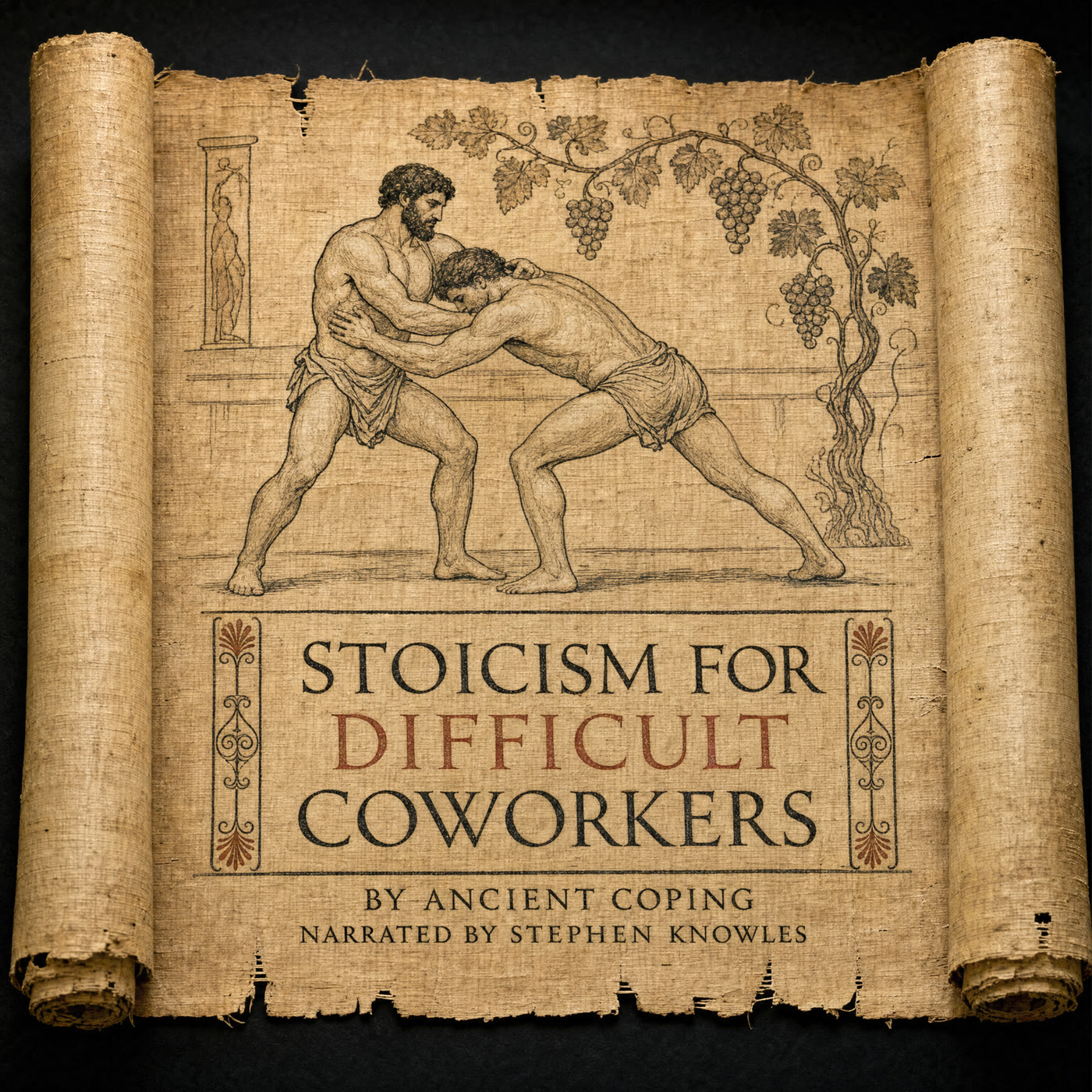
This letter covers one situation from Stoicism for Difficult Coworkers, a forty-minute audiobook that follows a warehouse supervisor through a credit taker, a chronic complainer and a colleague whose polite emails sting. It also covers how to read a nasty message so it loses its force, how to stop catching other people's bad moods, how to tell when you've become the difficult coworker yourself, and the story of a man mocked by name in a packed theater, who answered in a way people talked about for centuries.