You pull into the lot at 6:10. Happy hour started forty minutes ago. Through the restaurant window you can see your coworkers around a long table, someone mid-story, everyone leaning in. You turn off the engine and stay where you are.
You check your phone. Nothing has come in. You check it anyway, because a phone is a reason to sit here. You run lines. Hey, sorry, traffic. Where do you sit? What if the only open chair is in the middle? What if someone asks what you've been up to?
You could text that something came up. Nobody would mind. That thought, oddly, makes you feel worse.
Here is the short answer to the question you typed. You probably won't stop the feeling first. What you can change is what you do with it, and where you put your attention. Two Roman writers, Seneca and Epictetus, spent real time on exactly this.
Your body isn't a verdict on your character
Seneca wrote a letter to his friend Lucilius about a promising young man who blushed whenever he spoke. Seneca took it as a good sign. Then he made a point that most of us never hear.
As Seneca put it, roughly: no amount of wisdom removes the natural weaknesses of the body. Training can soften what's built into us, but it can't conquer it. He said some of the steadiest, most experienced men he knew still sweated, trembled and lost their voices when they had to speak in public. He added that an actor can fake fear or grief on stage, but nobody can make himself blush on command.
Keep the context in mind. Seneca was a wealthy Roman statesman. In his world, speaking in public was how a man built a career, so this was not a small worry. Yet he put the blush, the sweat and the shaky hands on the side of the line that isn't up to you.
Today that means a racing heart before a call, or a hot face in a meeting. That is your body doing what bodies do. It says nothing about whether you're competent, likable or fit to be in the room.
Stop fighting the blush
Think about what you do when your face starts to burn. You fight it. Oh no, they can see it, stop. That alarm about the alarm is what stretches one minute of heat into ten.
Try this instead. When the signs show up, describe them to yourself plainly. Tight chest. Warm neck. Fast heartbeat. Then say, there it is. Carry on with what you were doing, the way you'd carry on through a cough.
You aren't trying to make it vanish. You're refusing to treat it as an emergency. Very often it fades faster once you stop arguing with it.
The parking lot rehearsal is a different problem, and Seneca had a line for that too. He wrote it to the same friend, about fears that run ahead of events:
"There are more things, Lucilius, likely to frighten us than there are to crush us; we suffer more often in imagination than in reality." (Seneca, Letters to Lucilius 13)
He was telling a friend to look at what was actually in front of him, not at the disasters he'd scripted. The modern version is the forty minutes you spend dreading a twenty-minute event. The event is usually the shortest part of the ordeal. The dread before it and the replay after it take up the rest.
Get out of the mirror and into the room
In his Discourses, Epictetus describes a student who finishes a speech and immediately asks the audience, "But how did I treat of that particular matter?" Epictetus mocks him. The student was never really talking about the subject. He was after applause.
You may think that has nothing to do with you. You don't want applause. You want to disappear.
Look closer. The show-off and the anxious man are asking the same question all day: How am I coming across? One hopes for praise. The other braces for a verdict. Both are watching themselves from the cheap seats instead of taking part in the conversation. And every second you spend checking your face, your voice and your posture is a second you aren't listening. Then you miss what someone said, and the loop tightens.
Epictetus's advice in the Handbook is a relief here. Roughly: in company, you don't need to say much. Say what's needed, listen, and don't go on about yourself. You're not required to perform. Nobody hired you as the entertainment.
The move is simple. When you catch how am I doing?, swap it for what is actually going on out here? What is this person saying? What's the problem on the table? Think of it as moving your attention from the mirror to the window.
It won't feel natural at first. It's a muscle, and it gets stronger with use.
A practice for this week
Keep it small on purpose. Pick something that makes you a little uncomfortable, not terrified.
- Choose one low-stakes situation. Asking for tap water. A short call to a business. One sentence in a meeting. Replying to a message you've been avoiding. Write it down.
- Name the feeling beforehand. Say it plainly: tight chest, warm neck, fast heart. Then add, that's allowed.
- Shrink the task to the next physical step. Not "have the conversation." Just "press dial" or "walk to the counter." Do that, then ask what the next step is.
- Turn your attention outward. While you're talking, listen for one detail you didn't know. If your voice goes high or your face goes red, let it, and finish the sentence.
- Close it out. If the replay starts that night, tell yourself, that's finished. Then ask what the next thing is. Dinner. A shower. Sleep.
- Do the same thing again. Do it three times this week. Notice whether the second time was easier than the first. That's your signal to move up one small step.
One serious note. Everyone feels shy sometimes. But if anxiety is shaping your work, your friendships or your health, it's common and very treatable. Talk to a doctor. Talk therapies such as cognitive behavioral therapy are well established for this. If it has pushed you somewhere dark, or you're having thoughts of harming yourself, don't carry that alone: call or text 988 in the US, or contact emergency services, right away. Asking for help is not the shameful kind of thing.
This is the first rung of a longer climb, and it's worth taking slowly. Nobody gets credit for skipping steps.
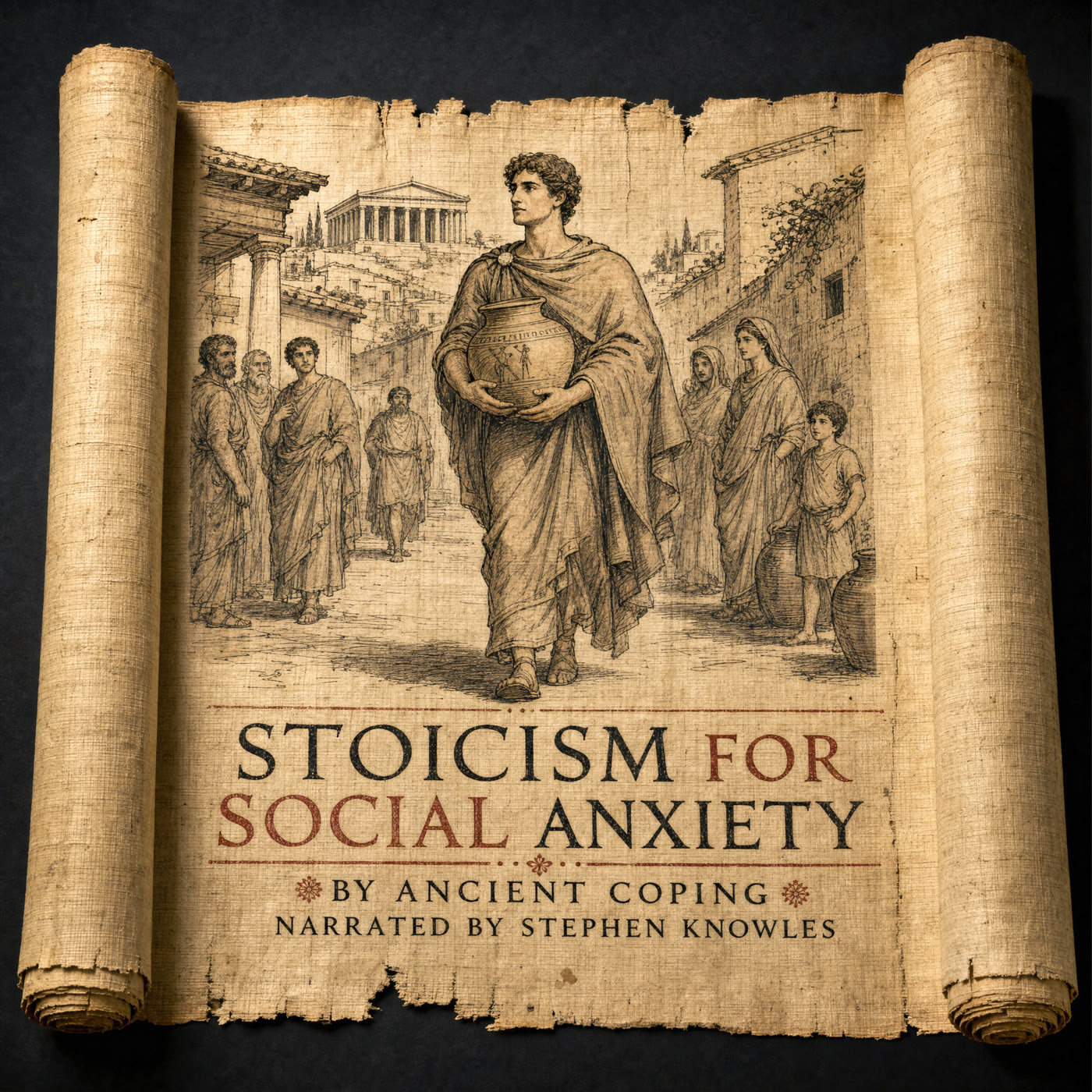
These ideas are the start of Stoicism for Social Anxiety, a forty-minute audiobook that goes much further. It covers Seneca's advice on choosing one wise person to keep "watching" you in place of a crowd of imaginary critics, and how Cato the Younger trained himself against the wrong kind of shame by wearing plain clothes and going out barefoot, as Plutarch tells it. It also lays out a full, graded ladder for building courage, Marcus Aurelius on doing only the next thing, and how to handle the moment something goes wrong in public. Along the way you'll follow a man named Ollie as he prepares a best-man speech, and you'll hear the story of a young merchant, a pot of lentil soup, and the most embarrassing walk through Athens in history.