All audiobooks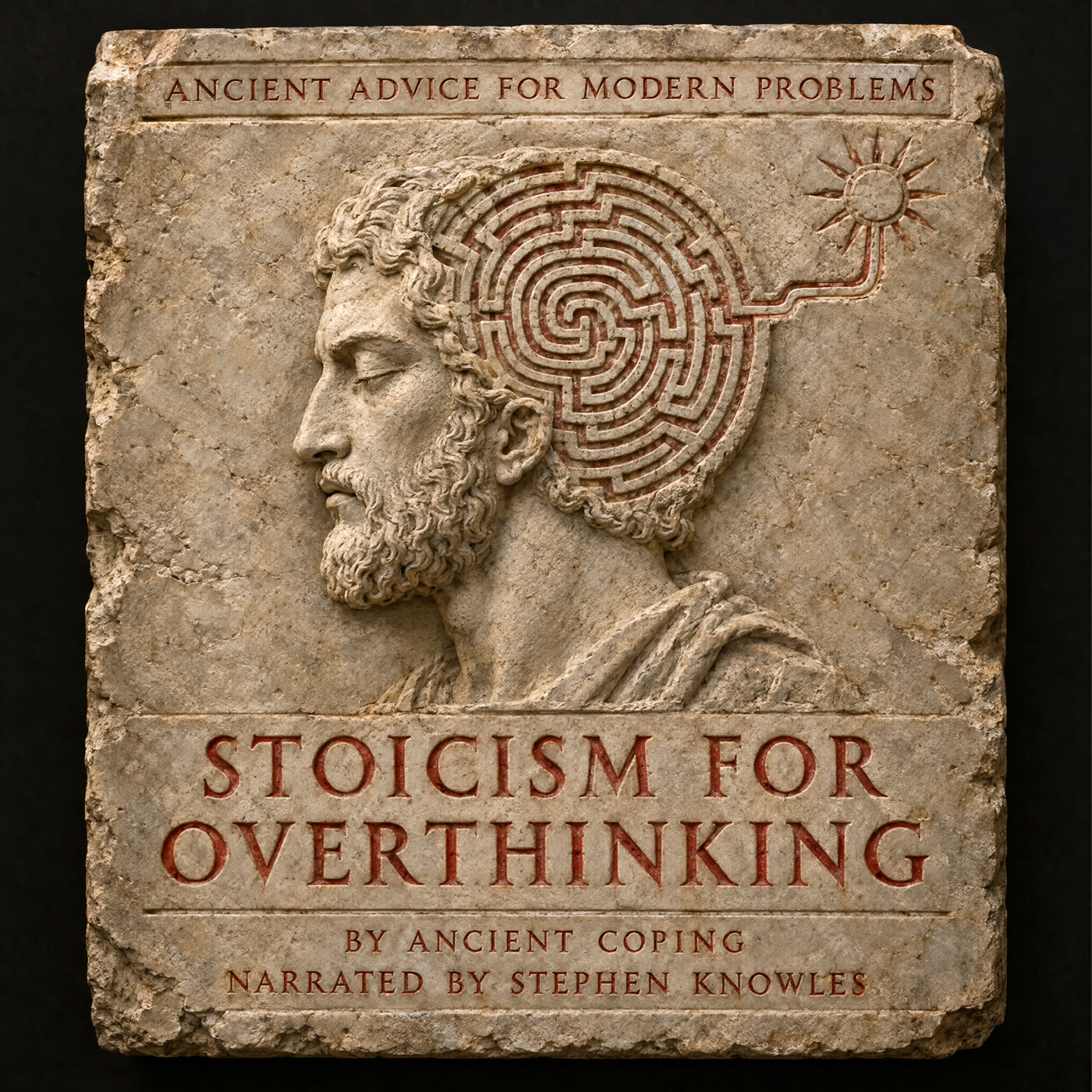
Mind & temper / 39m
Stoicism for Overthinking
Ancient Stoic Tools to Stop Worrying, Replaying, Second-Guessing, and Living in Your Head
Free sample: the trailer
0:00
Mind & temper / 39m
Ancient Stoic Tools to Stop Worrying, Replaying, Second-Guessing, and Living in Your Head
It is three in the morning. Your body is tired, but your mind has started another shift.
You replay yesterday. Rehearse Thursday. Check the decision again. Wonder what someone meant. Imagine the worst. Then return to the beginning and do it all over.
Stoicism for Overthinking applies the practical ideas of Seneca, Epictetus, and Marcus Aurelius to a very modern problem: a mind that will not stop working even when the thinking is no longer useful.
The Stoics did not call it overthinking. They wrote about the disturbed mind, imagined suffering, uncontrolled impressions, unnecessary thoughts, and the habit of running ahead into events that have not happened.
You’ll discover:
The goal is not to stop thinking. It is to stop treating every thought as a problem that requires another hour of thought.
The audiobook also includes a practical companion guide to help you separate genuine problems from repetitive mental loops and turn useful thinking into clear action.
We'll email you the first chapter of Stoicism for Overthinking after you confirm your address.
It is three in the morning. You are awake. Not because of a noise, or a child, or a full bladder. You are awake because your mind has switched itself on and will not switch off. It is replaying something you said yesterday. Then it is rehearsing a conversation you have to have on Thursday. Then it is wondering whether that pain in your side is something serious. Then it is back to the thing you said yesterday, with a new angle. Then it is calculating, again, whether you can afford the thing you have already decided to buy. Round and round. Each thought feels urgent. None of them gets anywhere. By the time the alarm goes, you have done a full shift of thinking and solved nothing. You get up tired. And tonight, there is a good chance it will happen again. If this is familiar, you are an overthinker. And you are in good company. Because about two thousand years ago, a group of philosophers in Greece and Rome spent a great deal of their time on exactly this problem. They did not call it overthinking. They talked about the disturbed mind, the mind that runs ahead of itself, the mind that suffers from things that have not happened. But they were describing the same thing. And they came up with practical methods for dealing with it that are, frankly, better than most of what you will find in a modern self-help book.
Stoic Tools for Worry, Overthinking, Stress, and the Fear of What Comes Next
Stoic Lessons on Worry, Uncertainty, Acceptance, and Letting Go of Outcomes
Stoic Lessons for Mastering Anger, Irritation, and the Urge to React
A Practical Guide to Unfairness, Bitterness, Envy, Acceptance, and Knowing When to Fight Back