It's Sunday evening and you're parked outside your dad's house with the engine off. You've been there six minutes. You know because you keep checking your phone, as if it might hand you a reason to leave.
Inside, he's watching the game with the volume too high. There's a new scrape along the passenger door of his car, and he says it was somebody else's fault. Your sister texted you last week: Have you talked to Dad yet. No question mark.
You've rehearsed the first line in the shower and on the highway. Every version sounds either cruel or useless. So you go in, watch the game, talk about gas prices, and drive home having said nothing.
If you have a conversation like that waiting, you're not weak and you're not unusual. You're stuck between two voices. One says wait, it's not the right time. The other says you know what needs saying, and it gets harder every week. The first one sounds kind. Most of the time it's fear.
The Stoics spent a lot of time on how to speak. Here is what they'd tell you to do.
Find the sentence you actually mean
Seneca's friend Lucilius once complained that his letters were too plain. Seneca answered in his seventy-fifth letter. He wanted his writing to sound like two friends talking or walking together: easy, unforced, nothing put on. Then he gave the line that matters here:
Let us say what we feel, and feel what we say; let speech harmonize with life. (Seneca, Letters to Lucilius 75)
In his day, the temptation was polish. Fine phrases were how an educated Roman showed he was serious. In ours, the temptation is fog. We hint. We joke. We send a link about older drivers and call it a talk. We praise a guy's effort for six months and then act surprised when he's shocked by a performance plan.
So before you plan anything else, finish this sentence on paper: What I actually mean is...
Not I'm just a little worried about the driving. More like I don't think you're safe behind the wheel, and I'm afraid you'll hurt yourself or someone else. Not there are some development areas. More like your work isn't at the level the job needs, and if that doesn't change, this job won't work out.
Notice how short the true version is. Notice that it scares you a little. That usually means you've found the real one.
Plain doesn't mean harsh. It means the other person leaves knowing what you meant. Fog treats people as if they can't handle the truth. Plainness treats them as adults.
Say it early, say it short, then stop
The Handbook, a short manual of Epictetus's teaching put together by a student, has a rule about speech. Roughly: keep quiet for the most part, or say what's necessary, in few words.
Nervous people do the opposite. We build a long runway of thanks and apology before the plane ever leaves the ground. I really appreciate everything you do, and this isn't easy for me either, and I've been thinking about this a lot... By the time you reach the point, the other person has guessed it, braced for it, and started building a defense.
Marcus Aurelius, who could have used any tone he liked as emperor, left himself a note in the Meditations. Roughly: speak plainly and without affectation, to a senator or to anyone. Don't put on a voice.
Here's how that works in practice:
- A greeting is fine. A line of real warmth is fine. (I love you, and that's why I'm bringing this up.)
- Within the first minute, say your one sentence out loud, in words a kid could follow.
- Then stop talking.
That last step is the hardest. Silence after a hard sentence feels unbearable, and you'll want to explain it or take half of it back. Don't. The silence is where the other person starts to take it in. Count three slow breaths. It's shorter than it feels.
There's a practical bonus too. When your heart is pounding and your mouth is dry, a long speech falls apart. One sentence survives.
Ask before you prove
Saying the sentence is half of it. The other half is not arriving like a lawyer with a folder of evidence.
Epictetus admired Socrates, and in the Discourses he describes how Socrates argued. Roughly: Socrates never lost his temper and never insulted anyone. He didn't need people to agree with him. He asked question after question until the other man saw the contradiction himself. Epictetus adds a joke. Try that on an important man in the street today, and he may tell you to mind your own business, or hit you. So use some care.
The principle holds, though. A conclusion a man reaches himself is different from one handed to him. He defends the first and resists the second.
After your sentence, ask real questions. They have to be real. A trap is just an accusation with a question mark.
- To a father: What was it like when that van came through the intersection?
- To a colleague: How do you think the last three projects went? What's getting in the way?
- To a partner: When did you last feel close to me? Do you feel it too?
Then listen more than you talk. Sometimes the answer tells you something you didn't know. That isn't the method failing. That's the method working.
Two more habits keep this honest.
Rehearse their best reply, not your worst fear. Lying awake picturing the blowup isn't preparation. It's a horror movie you're directing for an audience of one. Instead, imagine the fairest thing the other person could say back. Your dad: If I give up the car, I lose my independence. Your employee: You never told me. Every review said I was fine. Your wife: I've been lonely too. Now you're getting ready to listen instead of bracing for a fight.
Be glad to be corrected. Marcus wrote, roughly, that if anyone could show him he was wrong, he would gladly change, because the truth never hurt anyone. Stay firm on your one sentence. Stay open on everything around it. You might be right about that. Tell me more. It's how you avoid winning the argument and losing the person.
Your plan for this week
You don't have to do the whole thing by Sunday. You have to do the next step.
- Day one. Write down the name of the person and the subject. Nothing else.
- Day two. Finish the sentence: What I actually mean is... Don't soften it.
- Day three. Trim it to one or two sentences. Say it out loud three times. Then practice the three breaths of silence.
- Day four. Write two or three questions you'd honestly want answered, whatever the answer turns out to be.
- Day five. Give the other person their best reply, in their own voice. Find the part that's true and decide what you'll say about it.
- Day six. Pick a time and place. You want both of you rested, sober and not rushing, in private. Ask for it plainly: I'd like to talk about something properly. Could we have an hour Saturday morning? Put it on the calendar within the week. There is no perfect hour, and the part of you that avoids this will find a flaw in every one.
- Day seven. Have the conversation, or the first part of it. Within a day or two, check in briefly. Thank them for listening and confirm one small next step. People rarely agree to a whole new arrangement in one evening. They'll often agree to a driving assessment, a weekly walk, or a Tuesday meeting.
If it goes badly, remember what was yours: saying a true thing, kindly, at a decent hour. Their reaction never was. Don't chase. Say this clearly hit hard, let's pick it up in a few days, and then come back. Plenty of first reactions aren't final answers.
One caution. If the person has been violent, threatening or abusive, or you're afraid of how they'll react, don't do this alone. Talk to a counselor, an abuse support service or someone you trust first, and pick a safe setting. If anyone is in immediate danger, call emergency services or a crisis line.
The Stoics would add one more thing. The conversation you're avoiding is still happening. It's happening in your head at 3 a.m. and in the silence at dinner. The only choice is whether it also happens out loud, where it can change something.
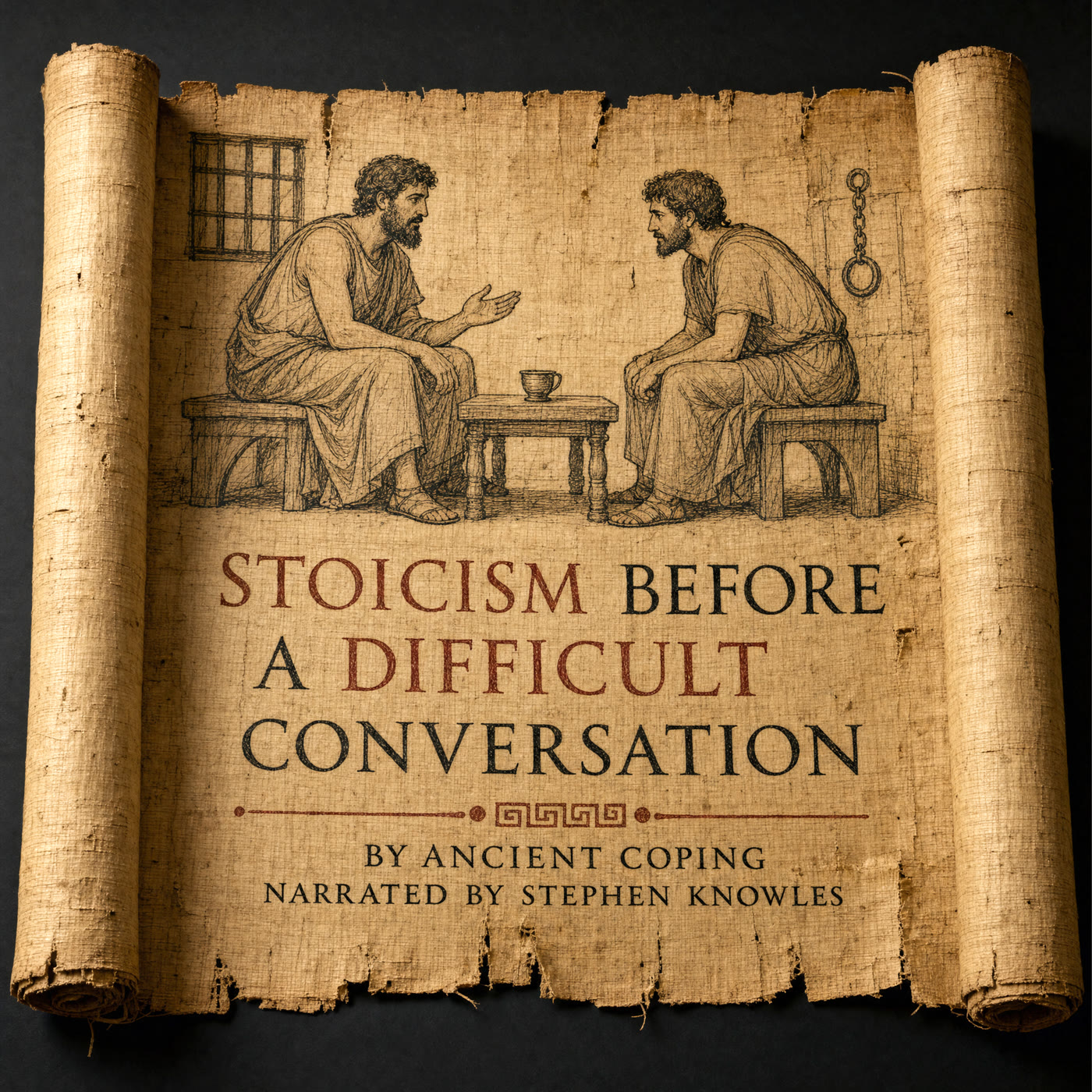
This is the core of Stoicism Before a Difficult Conversation, and the audiobook goes further. It follows one man, Will, through three conversations he has put off for a year, with his father about driving, an employee about his work, and his wife about the distance between them. It adds the tools for choosing the hour, giving a truth to someone who cries or gets angry, and following up afterward. It also covers the three common ways to misuse the Stoics, and ends with Socrates' last conversation in his prison cell, one of the oldest and best lessons in how to speak when it matters.