It's Saturday, around four in the afternoon. You've been in the apartment since Thursday night. The only voice you've heard is the one on a podcast. You walk to the corner store for milk, and when the cashier asks how you're doing, your "fine, thanks" comes out rough, like a door that hasn't been opened in a while.
Nothing is wrong, exactly. Nobody died today. There's just a lot of quiet, and a thought is starting to form in it: this is how it is now.
That thought is worth examining. Some of it is true. Most of it isn't.
Alone is a fact. Lonely is a verdict.
Epictetus was born a slave in what is now Turkey, around the year 50. After he was freed, he became one of the best-known teachers in the Roman world. A student named Arrian wrote down his lectures, and we have them as the Discourses. One lecture (Book 3, chapter 13) takes up exactly this subject.
Epictetus makes a distinction, roughly like this. Being lonely is the condition of a person who feels helpless, exposed, with nobody on his side. It isn't the same as being by yourself. You can be lonely in a crowd. You can spend a day alone in the garage and feel fine.
In his time, that was a practical point. His students knew exile, death and long separations from family. Being alone was ordinary. Feeling abandoned was a separate thing, and he wanted them to see the gap between the two.
Today it looks like this. "I haven't spoken to anyone since Thursday" is a fact. "Nobody would notice if I disappeared" is a verdict your mind added. The fact might be hard. The verdict is a story, and stories can be questioned.
Try it with a pen. Write the fact in one plain sentence, like a line in a report. Then write the verdict underneath. Look at them side by side. One is a description. The other is an accusation, and you never gave it a hearing.
A fair rewrite of the verdict usually sounds like this: I'm alone this weekend because my friends are busy, I moved, or I let things slide, and I haven't yet built what I need. That sentence leaves a door open. The first one shuts it.
Why it gets harder the longer it runs
Marcus Aurelius was emperor of Rome and almost never alone. His private notebook, the Meditations, still keeps coming back to one idea: people belong to each other. Early in the book, he reminds himself why he can't just withdraw from the people he finds difficult.
We are made for co-operation, like feet, like hands, like eyelids, like the rows of the upper and lower teeth. (Marcus Aurelius, Meditations, 2.1)
Elsewhere he says, roughly, that a branch cut off from the branch beside it is cut off from the whole tree. But he adds that a person can rejoin. He also warns that the more often you cut and rejoin, the harder the healing gets.
Marcus was writing about quarrels and contempt, not about apartments and remote work. But the pattern carries over. Many men tell themselves, "I'm just not a people person." Sometimes that's true. Often it's a habit wearing a personality's clothes. Each canceled plan and each ignored call makes the next reach-out feel a little steeper.
The good news runs in the other direction too. Each small reconnection makes the next one easier. You don't need a new social life. You need one more contact than you had last week, and then to keep it going.
Be useful to someone
When you're lonely, your attention turns to what's missing. Nobody calls. Nobody comes by. Seneca, in his letters to his friend Lucilius, suggests turning it around.
In one of them (Letter 9), he asks whether the wise man, who is supposed to be self-sufficient, needs friends at all. His answer, put in my own words: yes, he still wants them. Not so that someone will sit by his bed when he's sick, but so that he has someone whose bed he can sit beside.
Musonius Rufus, a Roman Stoic teacher and Epictetus's own teacher, made a similar point with bees. A bee can't live apart from the hive, and people aren't built to live for themselves alone.
To be fair, these men had slaves, status and a social order that looks nothing like ours. You can leave that part behind. The practical point survives. Being useful gives you a reason to leave the house. It gives you a role, and conversations that have something to lean on, which many men find easier than talking about nothing.
So ask a different question. Instead of "Who will call me?" ask "Whose bedside could I go to?" That might mean:
- Mentoring a younger guy in your trade
- Driving an older neighbor to appointments
- Volunteering at a food bank on Saturday mornings
- Joining a Men's Shed or a community workshop, if there's one near you
One caution. Don't let busy-ness become a hiding place. Helping others is meant to open a door into other people's lives, not to keep yours shut. Let somebody know you, too.
A practice for this week
You don't need all of this at once. Work through it in order, and keep each step small.
- Monday: split the fact from the verdict. Write one line for the fact of your loneliness and one for the verdict. Then write the fairer version of the verdict.
- Tuesday: give the day a frame. Pick three fixed points: a time to get up and get properly dressed, one walk outside in daylight, and one person you'll contact, even briefly.
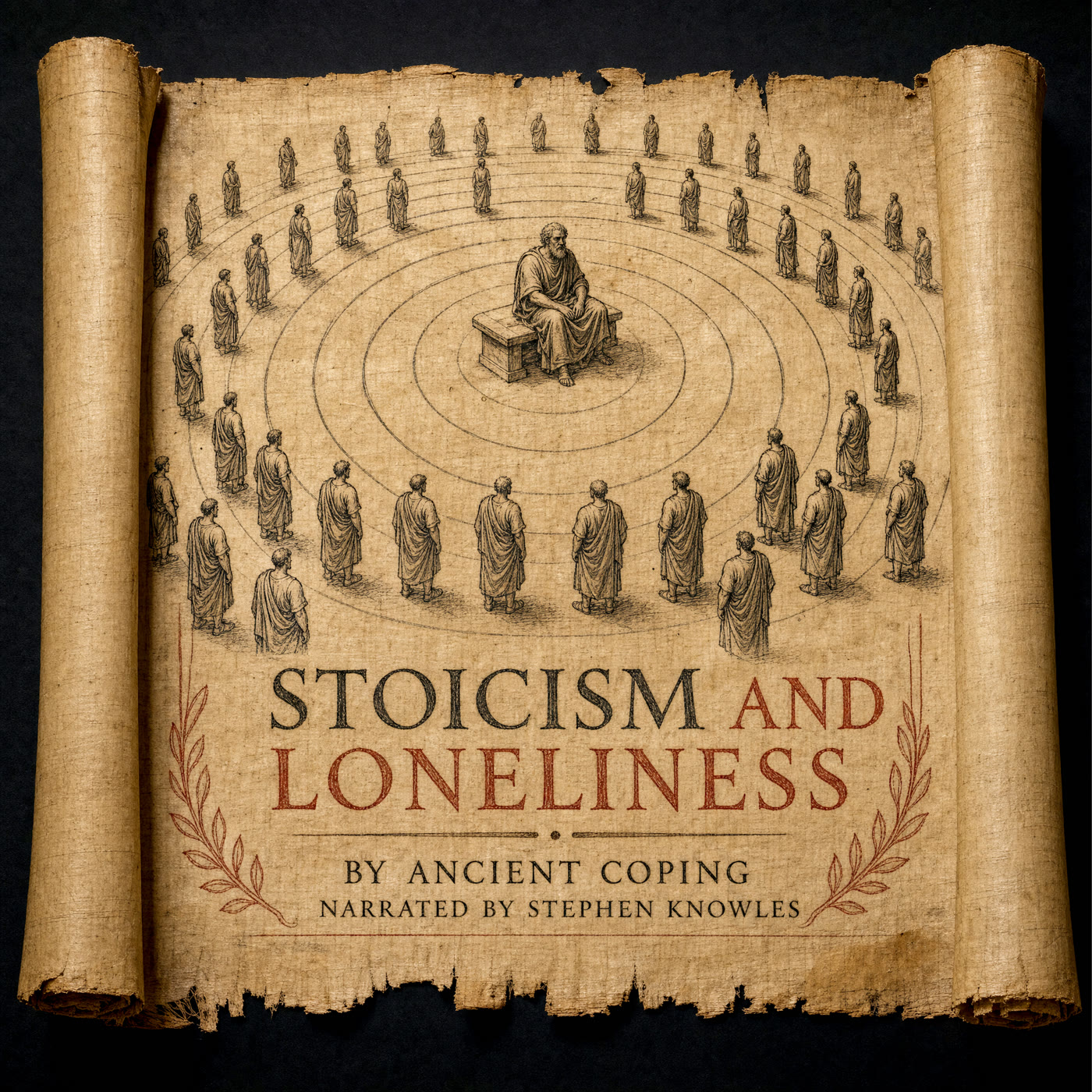
- Wednesday: map your people. Draw a small circle with your name in it. Draw rings around it for family, friends, neighbors, old coworkers. This follows an image from the Stoic Hierocles, who told people to pull the outer circles closer in. Pick one name from an outer ring and decide on one action that moves that person one ring closer. A text. An invitation. A call on his birthday instead of a like on his post.
- Thursday: make the call. Do it, then do the part that matters: say, "Want to do this every other week?" Put it in your calendar. One call is a gesture. A standing call is a connection.
- Friday or Saturday: find your bedside. Look up one place to be useful. Go once. Most groups need three or four visits before you stop being a stranger, so plan on going back.
- Sunday evening: ten minutes with yourself. No TV, no phone. With a notebook, ask what you'd ask a friend at the end of his week. What went well? What was hard? Answer honestly and kindly. Seneca tells of a Stoic named Hecato who said his progress in philosophy was that he had begun to be a friend to himself. That's the aim here.
None of this will make the quiet vanish by Sunday. It's meant to turn a slide into a direction.
When it's more than loneliness
If you've felt flat or hopeless for weeks, if your sleep or appetite has changed, if you're drinking more than you used to, or if you're thinking people would be better off without you, talk to a doctor or a counselor. Don't try to philosophize your way through it alone. In the US, you can call or text 988 at any hour to reach the Suicide & Crisis Lifeline. Grief counselors and support groups exist for exactly the kind of loss that makes a house go quiet.
The Stoics weren't asking anyone to need nobody. Seneca's whole point was that even the self-sufficient man wants friends. What they wanted was a man steady enough that his need for people doesn't turn into desperation, and generous enough to be good company when he finds them.
This letter drew on Stoicism and Loneliness, a forty-minute audiobook in our Ancient Advice for Modern Problems series. It goes further on the pieces we only touched here: carrying grief for someone you've lost without sealing yourself in with it, using the circles to rebuild your inner ring, building the structure of a day when work no longer supplies it, and what Epictetus meant by a god who is completely alone at the end of the world and still not lonely. It follows two men, one retired and widowed and one newly moved to a city where he knows nobody, and gives you a seven-day plan to start with.