It is a little after seven on a Tuesday. You are at the kitchen table with the laptop open, and three small things have happened today.
The company you pitched two weeks ago wrote back. We've decided to go in a different direction. At lunch you saw that the job you interviewed for went to someone else, and he posted a photo of his first day. And on your phone, under the message you sent Saturday, there is one gray word. Seen.
Nobody yelled at you. Nobody was cruel. But a voice in your chest has already drawn a conclusion: it's me. There's something about me people don't want.
That last step is the one worth looking at. Because the three noes happened. The conclusion didn't. You added it.
The no is an event. The verdict is yours.
Epictetus taught in Greece in the first and second centuries. He had been enslaved as a young man, and he knew something about being treated as if his worth were someone else's to decide. His student Arrian wrote down his teaching, and later boiled it into a short handbook. Near the start of it comes a line that sounds almost too simple:
Men are disturbed, not by things, but by the principles and notions which they form concerning things. (Epictetus, Enchiridion 5)
In his time, he was making a point about fear, with death as the big example. Death is not what frightens us, he says. Our judgment about death does. The same split works on something much smaller than death.
The event: an email said no. The judgment: so I'm not good enough, and it will keep happening. The first is a fact. The second is a story, and it came from you, at 7 p.m., tired and hungry.
This does not mean it shouldn't sting. It stings. A no from a person you wanted something from will always cost you a little. Epictetus is not asking you to feel nothing. He is asking you to notice which part of the hurt belongs to the event and which part you wrote yourself.
Hand back what isn't yours
Marcus Aurelius was emperor of Rome, and you would think nobody's opinion could touch him. His private notebook, the Meditations, says otherwise. He keeps coming back to being judged and looked down on, because he kept needing the reminder.
In one passage he writes: "Suppose any man shall despise me. Let him look to that himself. But I will look to this, that I be not discovered doing or saying anything deserving of contempt."
He is dividing the situation in two and giving one half back.
- Their part: what they decided, what they think, what mood they were in, who else they were considering. You can't see most of it. You can't control any of it.
- Your part: whether you acted in a way you can stand behind.
Silence makes this harder, because silence lets you write the other person's thoughts for them. The match who left you on read. The friends who made plans without you. The recruiter who never replied. You don't know what they think, but you fill in the gap anyway, and you almost always pick the cruelest version.
So ask one question, and only one: Did I do anything here I'd be ashamed of? Was I rude, careless, dishonest?
If yes, that is useful. You know what to fix, and fixing it is entirely in your hands. If no, you are finished. The rest was never yours to carry.
One warning. This is not a license to wave off everything as other people's opinions. If three clients in a row say your price is too high, that is information, not a private mood. Marcus said their contempt is theirs. He also said your conduct is yours, and sometimes the honest answer is yes, I could have done better. Then you do better.
Count the throws, not the losses
Seneca, the Roman statesman, wrote a great deal about Fortune, whom the Romans treated as a goddess who hands out gifts and takes them back for no stated reason. As he put it in his letters and essays: "Fortune has no jurisdiction over character."
Now look at a pitch. Whether it lands depends on a budget you can't see, a candidate you've never met, and the mood of whoever opened the email. That part is dice. What isn't dice is how many times you throw, and how carefully you prepare each throw.
Most of us never count. We remember every no as one of a hundred, when it was often one of three. A freelancer who sits down with a notebook may find he sent fourteen pitches in six months, not the fifty he assumed. That isn't a verdict on his talent. It is a small sample, and a small sample can't tell you who you are.
So swap the question. Stop asking why did this one fail? You often won't find out. Ask: Was that a good throw? Am I throwing often enough? You can answer both, and both lead to something you can do.
A practice for this week
This takes about fifteen minutes in total, spread over a few days. You need a notebook.
- Write the no as a plain fact. One sentence, no adjectives. "The agency chose another candidate." Not "I got passed over again."
- Write the story you've been telling about it. "I'm not good enough." "People don't want me." Look at it next to the fact. Notice how much further it reaches.
- Ask the one question. Did I do anything here I'd be ashamed of? If yes, write down the fix and do it this week. If no, write "their concern" and close the page.
- Count your throws. In the area that hurts most, work, dating, friends, write down how many times you actually tried in the last month. Then set a weekly number you can hit regardless of the results.
- Send one thing by Friday. A pitch, a message, an application, an invitation. Make it a good throw: specific, clear, done properly.
- Keep your evening. Whatever comes back, do what you were going to do anyway. The gym, the game, dinner with a friend. Don't let the answer rearrange your day.
If you want one more move, ask the person who turned you down for a single thing you could do better. Many won't answer. Some will, and one honest sentence can be worth more than a month of guessing.
One more thing, plainly. If rejection is piling up and you've felt low for weeks, if sleep or appetite has gone, or you've started to feel hopeless or worthless, talk to a doctor or a counselor. Don't push through that alone. If you ever think about harming yourself, call a crisis line or emergency services where you live right away. Asking for help is one more ask, and it's one of the best you'll make.
The ancient advice comes down to this: you can't stop the no from landing, but you get to decide what you build on top of it. The event is small. The story is optional.
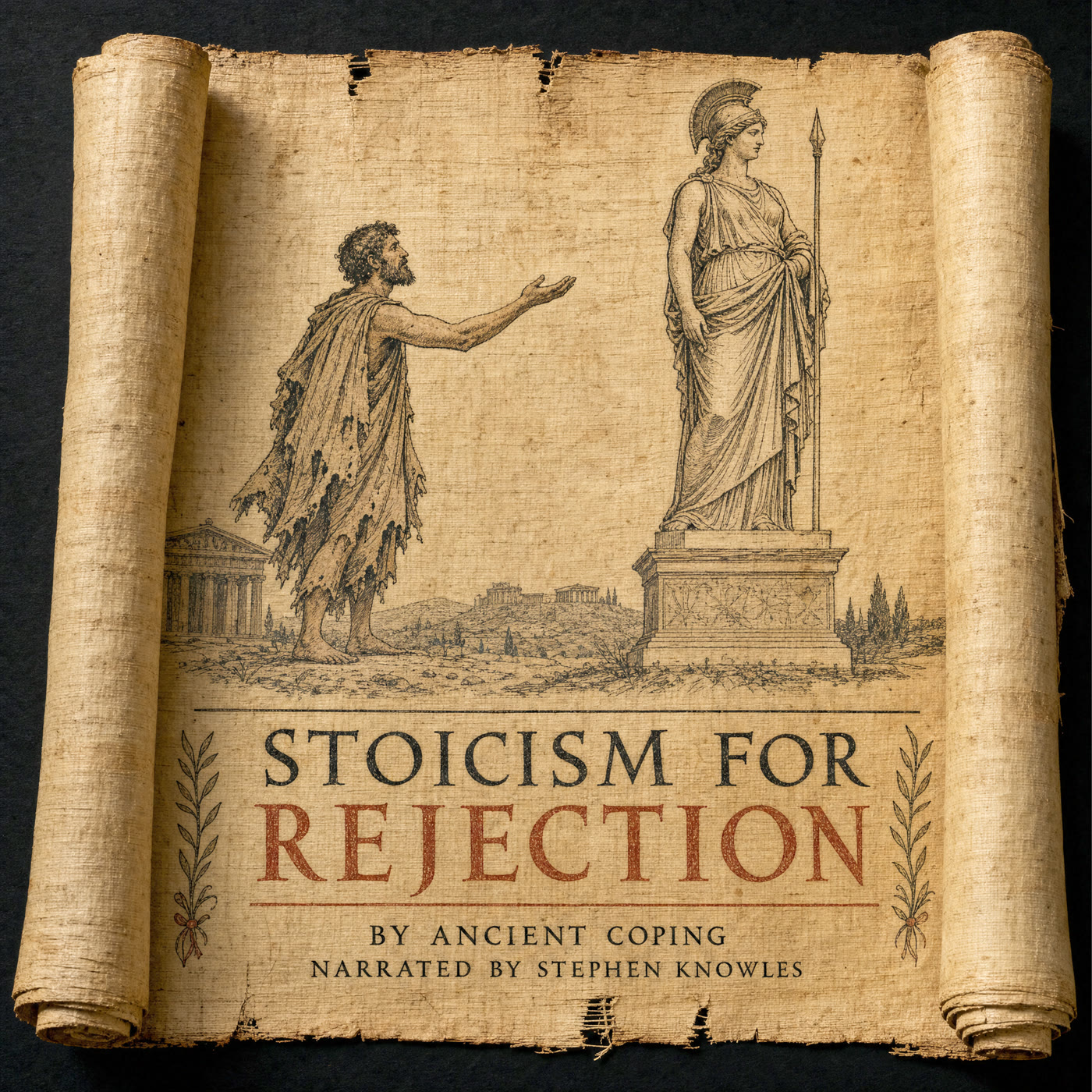
These ideas come from Stoicism for Rejection, which goes further than this letter can. It gives you five practical tools, including how to collect small refusals on purpose the way Diogenes did, how to want something fully without being wrecked when it doesn't come, and how to treat every no as training. It follows one freelancer through a bad few months, and it ends with the story of a Roman senator who lost a major election and then decided what to do with the rest of his day.