It is 4:52 on a Tuesday. An email arrives. The subject line says "Update on your application." The preview shows the first words: "Thank you for your time." You do not open it. You already know.
You turn the phone face down and finish the spreadsheet. You drive home with the radio off. By Thursday you have decided something about yourself. Nobody told you. You just know it now.
That last part is where this letter lives. Rejection is one thing. What you decide it means is another. A man who understood the difference better than almost anyone was a slave in Rome.
Separate what happened from what you decided
He was called Epictetus, which in Greek means roughly "acquired." That is a description, not a name. He was owned by a secretary of the emperor Nero. He had no family the law recognized, no property, and no say in where he lived. Later he was freed and opened a school. When an emperor expelled the philosophers from Rome, he was turned away by the city itself. He moved to Greece and started over. He wrote nothing. A student, Arrian, took notes, and those notes shaped a young Marcus Aurelius. Marcus says so in the first book of his Meditations.
Here is the idea he is best known for, in a public-domain English translation from 1758:
"Men are disturbed, not by things, but by the principles and notions which they form concerning things." (Epictetus, Enchiridion 5)
In his time, that was a claim about a world where a master could break your leg and you still owned your own judgment. Today it means something plainer. When you get turned down, two things happen so fast they feel like one.
The first is the event. They chose another candidate. She said she does not want to continue. He did not invite you. That is a fact, and it is unwelcome. Nobody is asking you to enjoy it.
The second is the verdict, and you wrote it yourself. I was not good enough. This always happens. I am the guy people pass over. The event stings. The verdict is what keeps hurting for months.
A quick test shows the difference. A stranger declines to sell you a newspaper. A club you never wanted to join does not admit you. Same shape, someone said no, and you feel nothing, because you attached no verdict.
Notice how much the verdict claims to know. One hiring panel's choice becomes a ruling on your whole worth. One woman's answer becomes a fact about all women. That is a lot to build on one piece of evidence.
Try it now with an old rejection that still has some heat. Write the event in one flat sentence, the way a stranger would report it. Then find the sentence you added, the one that starts with I am or I always or I never. One of those happened. The other you wrote.
Count what it cost, and what you kept
Epictetus had a small story about lettuce, and it is one of the most useful things in the Stoic tradition. Someone is preferred to you at a dinner, he says. A head of lettuce costs an obol, a small coin. A man pays his obol and takes his lettuce. You did not pay, so you did not get one. You have not come off worse. He has his lettuce, and you have your obol. A dinner at a rich man's table is sold for praise and attention. If you were not willing to pay that, you were not cheated. (This is in the Enchiridion, section 25. I am paraphrasing, not quoting.)
Now apply it. Most of what you were denied had a price. The promotion often goes to the guy who spent two years volunteering for the cross-team projects and getting to know people two levels up. If you kept your head down, did excellent work, and went home on time, you were not found unworthy. You did not buy that particular thing.
Then ask what you kept. The man who would not flatter kept his self-respect. The man who would not work every weekend kept his evenings with his kids. Before you grieve what you were not given, count what you did not spend.
This cuts two ways, and it is meant to. If you still want the thing, pay for it with your eyes open. Put in the hours, learn the skill, ask again. If the price is too high, stop resenting the people who paid it. You made a trade. Stand by it.
Some things, of course, have no price you can pay. No amount of effort makes a particular person love you. That leads to the next piece.
Aim at the asking, not the yes
Epictetus noticed that a musician plays fearlessly alone in his room and shakes in front of an audience. The audience changed what he wanted. He no longer wants to play well. He wants applause, and applause sits in other people's hands.
Every request you have been afraid to make works the same way. You wanted a yes, and the yes was never yours to give.
So shift the target. Hope for the yes, and work for it. But set your heart on the part that belongs to you. Did I ask plainly? Was I honest? Did I prepare? Did I treat the other person with respect? A man who aims there can be turned down, and he cannot fail. The asking is his. The answer is theirs.
In 1910 Theodore Roosevelt told a Paris audience that "The credit belongs to the man who is actually in the arena." He was talking about public life and its critics, in a speech titled "Citizenship in a Republic." He was a politician of his own era, and you do not need to agree with all of it. But the line fits here. The man who asked and heard no is in the arena. The man who never asks is in the stands with his dignity intact and nothing else.
That second man is a real risk. After a hard few months it is easy to call withdrawal "focusing on myself." Epictetus did not teach withdrawal. He taught men to go to the dinner, enter the contest, and speak up, without being owned by the result. If your outlook has made your life smaller, you are doing it wrong.
Your practice for this week
You do not need a notebook full of theory. You need three moves, spread over a few days.
- Day one: split one old rejection in two. Write the event as one flat sentence. Underneath, write the verdict you added. Read them side by side.
- Day three: run the price. Pick one thing you were not given. Write down what it cost, whether you paid it, and what you kept by not paying.
- Day five: draw the line before you ask. Pick something you want. Write two columns, mine and theirs. Under mine goes the preparation, the honesty, and the asking. Under theirs goes the answer.
- Day seven: make one real ask. It should be the thing you have been putting off. Say out loud, or to yourself, "I am here to ask well. The answer is theirs." Then ask, and let the answer be theirs.
If it goes badly, send the next application or message before the weekend is over. The cure for a no is rarely more thinking. Usually it is the next ask.
One honest caution. This is for the ordinary rejections of an ordinary life. If a loss has left you unable to function, if weeks pass and the heaviness does not lift, or if you start to feel that people would be better off without you, do not carry that alone. Talk to a doctor or a therapist, and tell someone close to you today.
Epictetus's own conclusion was that a man who can hear no without collapsing, and yes without losing his head, is free, whatever his station. Nobody becomes that in a week. But the first ask is a start.
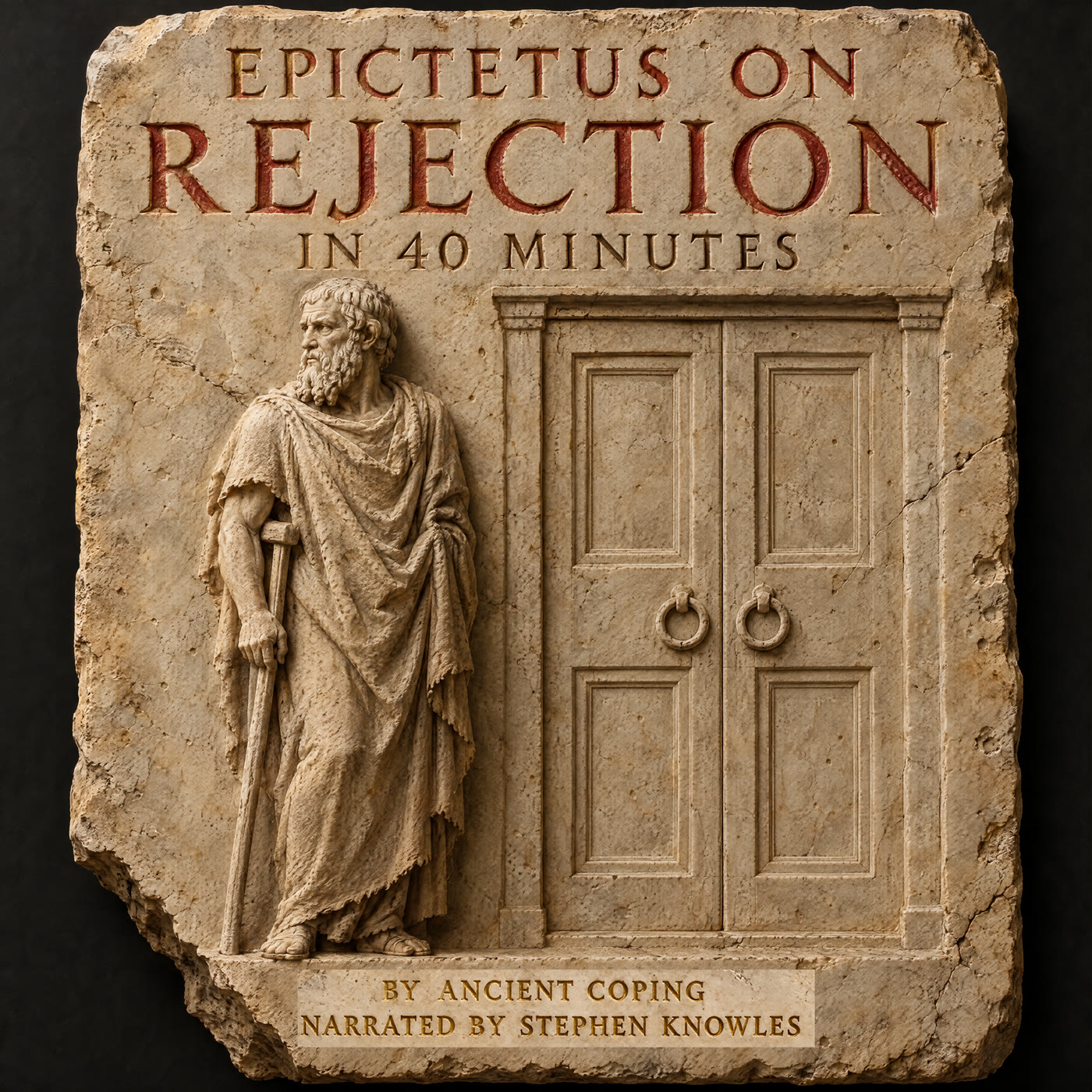
Epictetus on Rejection in 40 Minutes goes further than this letter can. It covers how to think about the person who said no, using a short phrase Epictetus taught for just that purpose, and his image of the "two handles" that every hard event has. It walks through six real moments, including when she says no, when the job goes to someone else, when you are left out, when something long ends, when your work is turned down, and when it is your father's approval you never got. It also names the two traps on this road, and ends with what a man who had been a slave meant by the word free.