Three weeks after the layoff, you are at the gym at 6 a.m. because it is somewhere to be. The line is painted above the squat rack in black capitals: WHAT DOESN'T KILL YOU MAKES YOU STRONGER.
You read it twice. You don't feel stronger. You feel like a man who lost his job and is lifting weights at an hour when nobody expects him anywhere. So either the sign is wrong, or you are doing something wrong.
Neither, quite. The line is real, and so is the man who wrote it. But the poster leaves out most of what he meant.
Where the line comes from
Friedrich Nietzsche wrote it in 1888, in a short book called Twilight of the Idols. It is one saying in a list of sharp one-liners titled Maxims and Arrows. It has a heading most posters drop. Roughly translated, it reads: from life's military school.
Now the life behind it. Nietzsche was a university professor at 24. At 34 he resigned because of illness. He had migraines that lasted days, eyes so weak he could barely read, bad stomach trouble, and almost no sleep. He spent his remaining working years in rented rooms, in a Swiss mountain village in summer and on the Italian coast in winter. He wrote books almost nobody bought. He wrote that line from inside all of it, not from a comfortable chair.
Was mich nicht umbringt, macht mich stärker. (Friedrich Nietzsche, Twilight of the Idols, Maxims and Arrows, 8)
In English: what does not kill me makes me stronger. Notice the word me. He was not announcing what hardship does to everyone. He was stating what he meant to do with it.
What the line leaves out
Nietzsche knew hardship does not automatically build anything. He had watched it make people bitter and cruel. In The Gay Science, he wrote, roughly, that he doubted great pain makes us better, but he knew it makes us deeper.
Deeper is the more honest word. Pain takes you below the surface, to where you find out what you care about and what you were leaning on. What you do down there is up to you.
Seneca, a Roman statesman writing about 1,800 years earlier, made a similar point. In On Providence, he said, roughly, that fire tests gold and misfortune tests brave men. He wrote for readers who believed the gods oversaw everything, and he was wealthy while he wrote it. Nietzsche had no such belief and no such comfort. But both treated hardship as a test of what you do next, not a prize for surviving.
Two misreadings are worth dropping:
- It is not a reason to go looking for suffering. Hardship arrives on its own. It is also no excuse to make life hard for other people so they will toughen up. After his death, people twisted Nietzsche's work to serve causes he had despised. The version here comes from his own pages.
- It is not a reason to grit your teeth and skip help. Nietzsche was ill for most of his life and saw many doctors. Getting help is often part of being strong.
Three ways to use it when things fall apart
Ask what it is showing you. Don't ask how this is making you stronger. That question can feel like a lie. Ask what you can see now that you couldn't before. Who showed up. What you can get through. What you had been leaning on without noticing.
Check your why. Nietzsche wrote, roughly, that a man with his own reason for living can put up with almost any how. Plenty of men have only one reason: the job, the body, being the provider. When that goes, the reason goes with it. Count the legs your why stands on. Work, family, a craft, friends, your health. One leg wobbles. Four stand.
Tend the garden. In Daybreak, Nietzsche compared a man to a gardener. You can't stop weeds from appearing, but you choose what to feed and what to cut back. The weed he warned about most was resentment. It feels like strength, but it means what happened to you is still running the show. If you spend your evenings reading about whoever laid you off, you are watering it.
Try this week
You don't need a grand plan. You need five small things, done on purpose.
- Monday: Think of a hard stretch from the past. Write one line on what it showed you. One line is enough.
- Tuesday: Write down your why right now. List its legs. Pick one you could add, and do one small thing toward it. Make a call, book an hour, or sign up for a class.
- Every evening, two minutes: Ask what you fed today. Choose one thing to feed tomorrow and one to cut back. Make the cut concrete: delete the app, skip the comment thread, leave the group chat that only stirs you up.
- Friday: Take a long walk without your phone. Nietzsche said, roughly, that thoughts worth having come while walking, and he did much of his best work on foot, even on his worst-health years. When everything feels stuck, the body can still move.
- Sunday: Tell one person you trust something hard you are dealing with. Don't ask for advice. Just make sure it isn't only yours to carry.
One more thing. If your hard stretch has turned into constant hopelessness, drinking to get through the night, or thoughts of not wanting to be here, don't tough it out alone. Talk to your doctor. If you are in crisis, call or text 988 in the US, or contact emergency services, today. Reaching out is not a failure of strength. It is how strength gets another chance.
The poster promises too much. The honest version asks for something smaller and harder: take what happened, go down into it, and decide what you will do there.
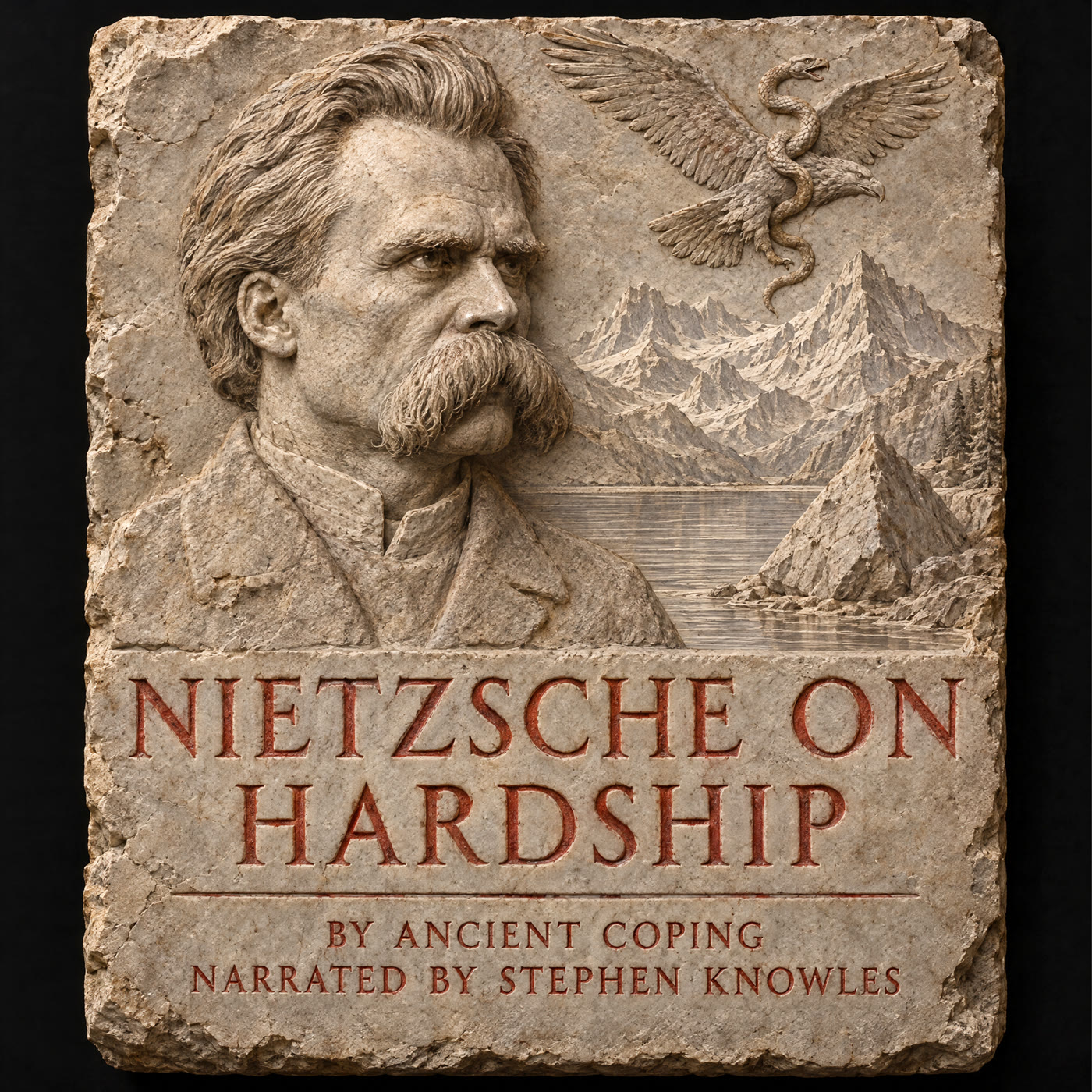
This letter covers the first part of the story. Nietzsche on Hardship goes further, in about forty minutes. It follows a man named Carl, who lost his job and wrecked his back in the same year, and it adds two more tools. One is the question Nietzsche called the heaviest weight, which he found on a walk beside a mountain lake. The other is his hardest idea, the love of fate. It also tells the story of what happened to Nietzsche in Turin in the winter of 1889, and what that means for everything he taught.