It's Saturday morning, and for once nothing is scheduled. No client, no kid's game, no errand for anyone. You make coffee. You stand in the kitchen. You realize you have no idea what you would do with this day if the choice were only yours.
You check your phone. You turn on the TV. By noon you feel a little scared, and you can't say why.
That feeling is common in your 40s, and it is not a sign that something is broken. It usually means you have been useful for a long time and have not been asked what you want. A French nobleman worked on this exact problem four hundred years ago.
Why Montaigne is worth your time
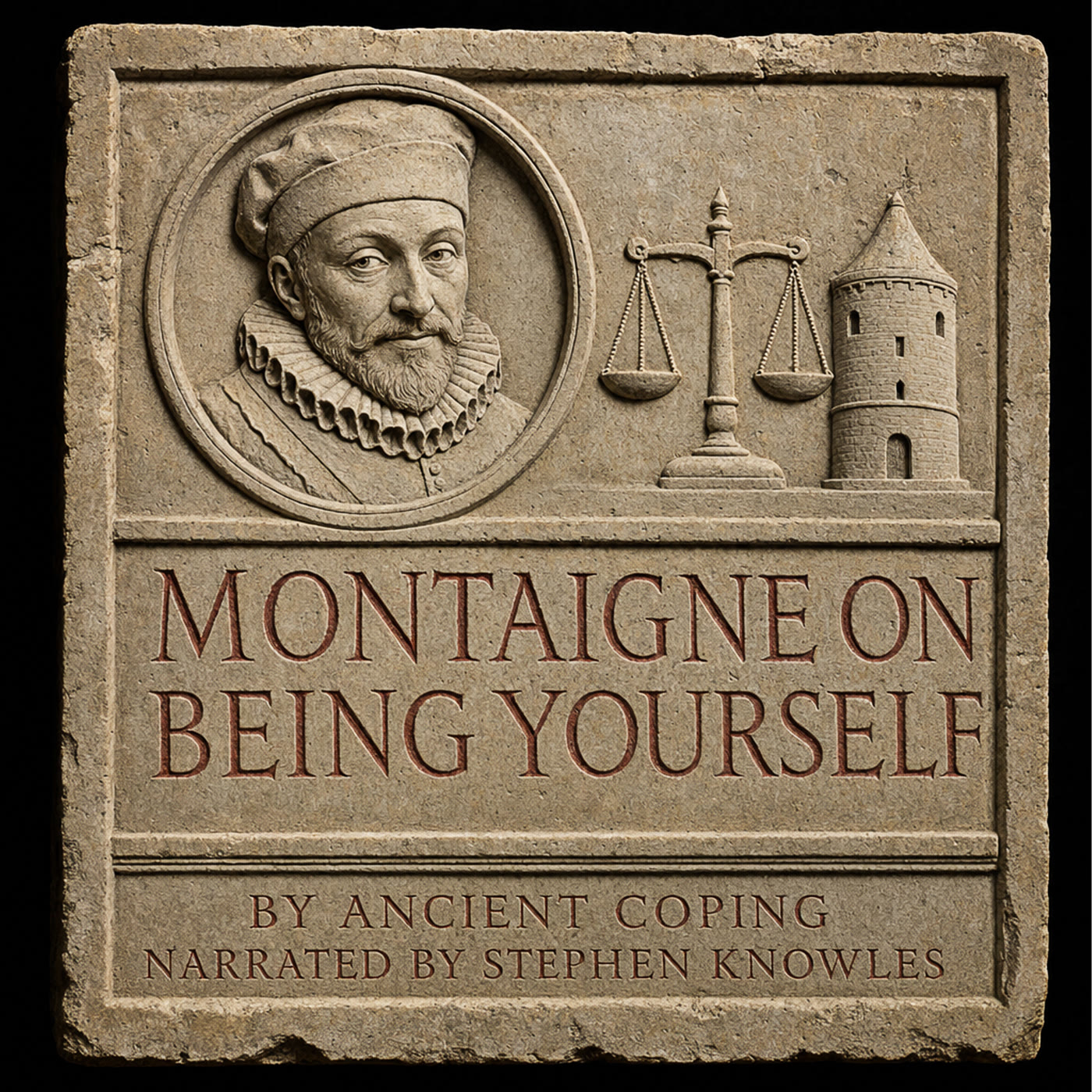
Michel de Montaigne spent years as a magistrate in Bordeaux. On his thirty-eighth birthday, in 1571, he climbed to the library on the top floor of a stone tower on his family estate and stayed there to write. He wrote about himself. He covered his moods, his bad memory, his laziness, his kidney stones, the friend he lost, and his habit of changing his mind. He called the pieces essais, meaning attempts or trials. He was trying himself out on paper.
He was not a Stoic, though he read them constantly. He was not trying to fix himself either. He wanted to know where the script other people had handed him ended and where he began. As he put it, "The greatest thing in the world is for a man to know that he is his own."
He also lived in a world that was not yours. He was wealthy, he had servants, and he could retire to a tower. You probably can't. But the questions he asked still work in a rented apartment or a spare corner of the garage.
Step one: separate the job from the man
Montaigne was later elected mayor of Bordeaux, a hard job in a time of plague and religious war. He did it seriously. But he wrote that the mayor and Montaigne were always two, and kept clearly apart.
He did the role well. He just didn't let it become his face.
The Roman teacher Epictetus, who had been a slave, made a similar point in his Enchiridion: "Remember that thou art an actor in a play, of such a kind as the teacher (author) may choose... For this is your duty, to act well the part that is given to you; but to select the part, belongs to another." Epictetus was talking about duty and fate. Montaigne was talking about identity. Both were saying the part is not the whole person.
Here is a quick way to test this. Take a sheet of paper and draw a line down the middle.
- Left side: your roles. Manager, husband, father, son, the guy who fixes everything, the one who is always fine.
- Right side: what would still be true about you if every one of those roles disappeared tomorrow. What you find funny. What you read or watch when nobody's looking. What you're curious about. What you believe. What you were like at fifteen.
The left side will take two minutes. The right side may take twenty, and some of it will be thin. That's normal. It is the side you have not been feeding.
Step two: build a back room
Montaigne's most useful idea is a small one. In his essay "Of Solitude," he said you should have a family, a career, and property, but also keep an arrière-boutique. That is the back room of a shop, where the shopkeeper goes when he isn't serving customers. He described it as a place entirely your own, where you talk with yourself as if you had no wife, no children, no job.
He wasn't telling you to leave your family. He was saying your happiness shouldn't depend entirely on them, or on the job. Then losing one of them won't leave you with no place to stand.
For most of us, the back room isn't a tower. It's a block of time and a spot to spend it. It could be Saturday from eight to eleven, a bench at the park, the workbench, the car parked a few minutes before you go in the house. The rules are simple:
- It's regular, so it doesn't depend on mood.
- Nobody is asking you for anything.
- It isn't work, email or scrolling. A back room full of notifications is just another office.
Tell the people you live with it matters. Most are fine with it once they understand, and they usually like the man who comes back.
Step three: pay attention to what you actually do there
Here is what people miss. Montaigne did not find himself by thinking hard about who he was. He found out by paying attention to what he did, liked, and said when he wasn't performing. He changed his mind often, and he treated that as data, not as failure.
He also distrusted his own certainty. He had a medal struck with a question in French, Que sais-je? "What do I know?" He meant that many of our strongest opinions are borrowed from our fathers, our friends, our offices, and we have never checked them.
He was just as clear about what the work is for. It is not for sitting around being interesting to yourself. It ends in living your ordinary days with your attention on them.
When I dance, I dance; when I sleep, I sleep. (Michel de Montaigne, Essays, III.13)
In his time that was a plain, almost stubborn remark. A life isn't made of big moves. It's made of dinners, walks, and conversations, and you can be in them as yourself or as a performance of yourself.
A week to try it
You don't need the whole method to start. Here is a first week.
- Day 1: Do the two-column page. Don't edit it. Keep it somewhere private.
- Day 2: Pick your back room. Choose a time and a place and put it on the calendar. Tell whoever needs to know.
- Day 3: Use it for at least an hour. Walk, sit, read something you picked for no reason. Leave work and the phone out of it.
- Day 4: Write one page on a small subject. "What I think about my father." "What I like about rain." "What I'd do if money didn't matter." Montaigne wrote about thumbs and smells and sleep. Don't show it to anyone. Don't worry if it contradicts what you thought last week.
- Day 5: Look at the right-hand column again. Add one thing you didn't know on Monday.
- Day 6: Tell one person you trust one true sentence instead of "fine." Something like, "I've been tired lately and I'm not sure why." Many people answer with a true sentence of their own.
- Day 7: Pick one ordinary moment, such as a meal, a walk, or a conversation. Be fully in it. When your mind drifts to the roles and worries, bring it back.
One caution. A separation, a layoff, or a milestone birthday can stir up more than questions about identity. If you feel low most days, hopeless, or you're drinking to fill the quiet, talk to a doctor or a therapist. You don't have to work that out alone. Talking with someone trained to listen is its own kind of back room.
Don't expect to finish
Montaigne wrote for twenty years and was still finding surprises at the end. He never reached a fixed answer to "who am I?" Neither will you. What changes is that you stop being a stranger to yourself, and you start making choices you can stand behind.
That Saturday morning from the opening is still yours. Nobody is asking you to figure out your life before lunch. Just put one hour of it somewhere you'd choose. That is a real start.
The full method is in Montaigne on Being Yourself, our forty-minute audiobook. Beyond what's here, it covers Montaigne's idea that we are patchwork rather than one fixed self, the weighing technique he used to test borrowed opinions, how to handle a job, a marriage, or a father's script that has swallowed you, three ways people get his advice wrong, and what he called the masterpiece of a human life.