It is 11:40 p.m. You are lying on your back with your phone face down on the nightstand, and you have already picked it up twice. The test result won't come until Thursday. Or the job offer. Or the call back from your brother. You know nothing will change tonight. Your mind is running the whole thing again anyway, from the top.
You are not weak, and you are not broken. You are gripping. Most men do it, because somewhere along the way we decided that worrying is a form of responsibility. If I am still holding it, I am still doing something.
Here is a better way to hold it, from two teachers who lived very different lives.
Why the grip feels like duty
Try this now. Make a fist and squeeze for fifteen seconds. Your hand starts to ache. Your forearm tightens. Your shoulder may join in. And the whole time, that hand cannot pick up a cup, shake a hand, or catch anything. A fist is strong, but it is closed.
Worry works the same way. It costs real effort, it feels like action, and it leaves your hands too full for anything useful. Men grip work, money, kids, plans and old grudges, and we grip them because letting go sounds like losing.
Laozi thought that was backwards. His teaching, in short: the soft outlasts the hard, and the man who learns to loosen his grip ends up with more of what matters, not less.
Two old answers, and how they differ
Epictetus was born a slave in the Roman Empire and later taught philosophy in Greece, around the year 100. A student wrote down his lessons in a short handbook. It opens like this, in George Long's 1877 translation: “Of things some are in our power, and others are not.”
In his time, that was hard-earned advice. A man whose body and freedom could be owned by someone else needed one place nobody could take from him: his own judgments and choices. Today it sounds like this. The result of the test is not in your power. What you do while you wait is.
That sorting is useful. Laozi goes at it from another side. We know very little about him. Tradition says he was an archive keeper in ancient China, and many scholars doubt that one man wrote the book. The Tao Te Ching, about eighty-one short chapters, took shape roughly 2,500 years ago. Much of it was aimed at rulers and powerful men who hoarded, overreached and refused to stop. He is less interested in sorting your life into two piles than in how you hold what is in front of you. One chapter uses a cup:
It is better to leave a vessel unfilled, than to attempt to carry it when it is full. (Laozi, Tao Te Ching, ch. 9, Legge translation)
In his day, that was a warning against taking too much power and wealth. In yours, it is a question about your calendar, your worries and your sense of duty. Is there any room left in the cup? Or does one small thing, like a late delivery, a sick kid or a bad email, make the whole day spill?
Three loosening moves
Laozi's book is full of images. Three of them are practical enough to use tonight.
Go around, not through. Laozi loved water. It does not fight a rock. It goes around, or under, and over time it wears down canyons. When you meet something that won't move, notice your first instinct, which is usually to push harder. Then ask the water's question: is there a way around? With a stuck argument, that might mean asking a question instead of making your point a tenth time.
Let muddy water settle. Laozi asks who can make muddy water clear, and answers in his own way: leave it still, and it clears slowly. Stirring only clouds it. When you are churned up, the urge is to think harder, decide now, send the message now. A decision made in the swirl is usually worse than the one you would make tomorrow. Waiting is not quitting. It is giving the mud time to sink so you can see what is actually there.
Leave room in the cup. Decide where your brim is, then stop below it. A cup three-quarters full can be carried.
There is more to each of these than a paragraph can carry. The book gives you the full method. Here is a version you can start with.
Your practice for this week
You will need a pen and about ten minutes a day.
- Name the fist. Write down one thing you are gripping that you cannot control. Be specific. “Whether I get the promotion” is better than “work.”
- Sort it, Epictetus style. Draw a line down the page. On one side, list what is in your power: what you do, say and prepare. On the other, what is not. Circle one item on the first side and do it today.
- Set a settling period. For anything that is churning you up, choose a time before you act. An hour for small things, a night for bigger ones. No replaying, no checking your phone, no turning it over. Walk, work with your hands, or sleep.
- Picture the glass. When the thought returns, imagine the worry as mud in a glass of water. Set the glass down on a table. Watch the mud drift down while you take three slow breaths. Then give your attention to what is in front of you.
- Find one full cup. Pick one thing in your week that is filled to the brim, such as evenings given to work or a stack of commitments. Make one rule that keeps it below the brim.
- Hand one thing over. If something is ready to be someone else's job or decision, tell them, “This one's yours.” Then don't take it back if they do it differently.
- Open your hand. At the end of the week, make the fist once more, then open it slowly. Your hand is still there. Nothing is lost.
You will clench again. That is normal. The practice is noticing, and opening it again.
What letting go is not
People get this wrong in three ways.
- It is not not caring. A father who steps back still loves his kid. Letting go releases your grip, not your love.
- It is not dodging your part. Laozi's advice is to do the work, then step back. The work comes first. Letting go is for what you have already done your part on, or what was never yours to hold.
- It is not a one-time act. It is a daily habit, closer to stretching than to flipping a switch.
One more thing. Sometimes the need to control everything comes from somewhere deeper: anxiety that will not switch off, or a steady dread that something terrible happens the moment you relax. If that is you, and it is hurting your sleep, your health or your relationships, please talk to your doctor or a professional. If you are ever in crisis, contact a crisis line or emergency services where you live. Don't carry that alone. Asking for help is not losing control. It may be the first real way of letting go.
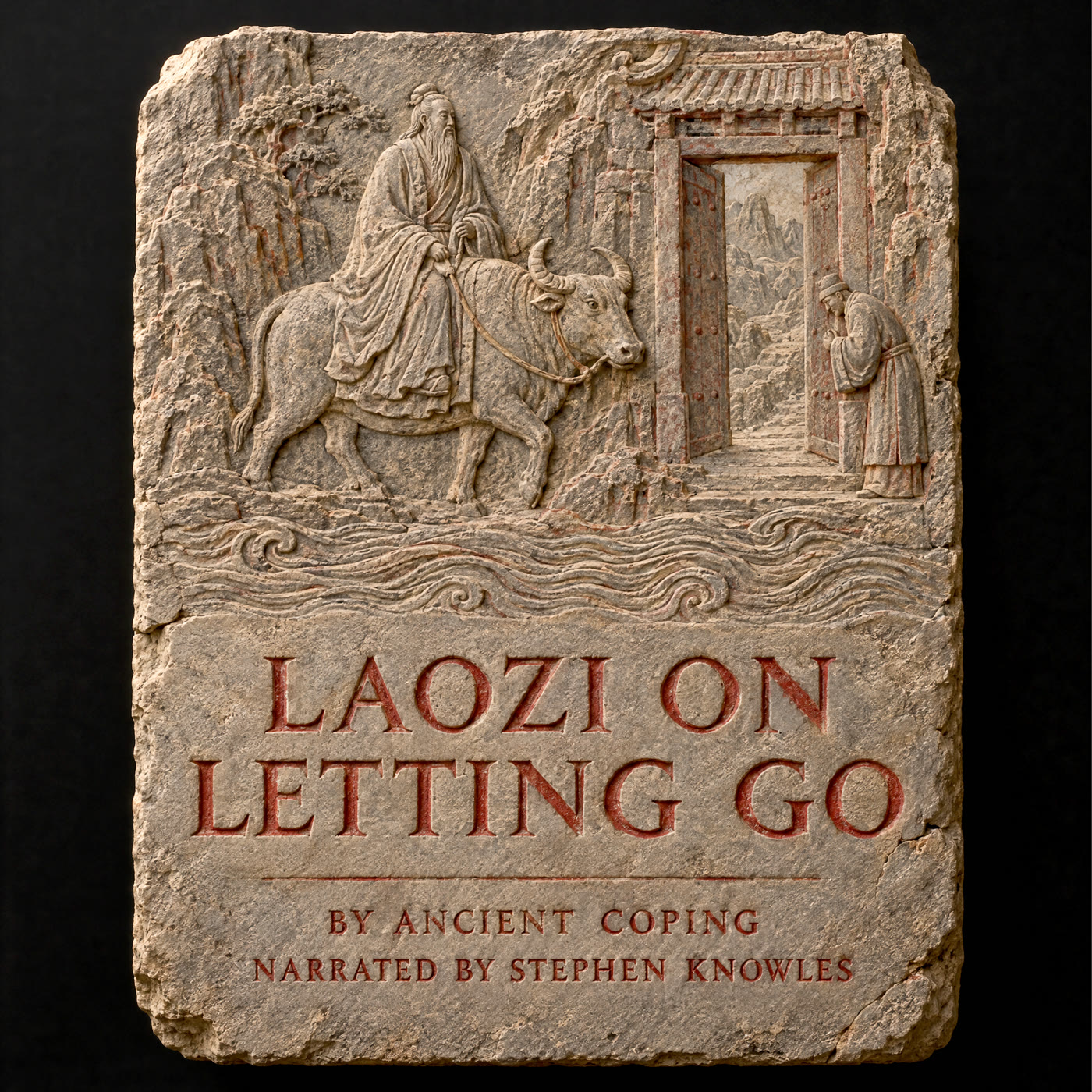
To go deeper, listen to Laozi on Letting Go, a forty-minute audiobook from Ancient Coping. It covers the story of the old master at the mountain gate, the full practice behind water, the cup, the muddy glass and the empty center of a wheel, and how to step back from work, grudges and kids who are growing up, followed by a seven-day plan and the story of a father learning to open his hand.