It's 2:40 a.m. You went to bed at eleven. Somewhere in the last three hours the thought came in without knocking: one day I won't be here. Maybe it followed a funeral. Maybe a friend your age, gone fast. Maybe a doctor's call that turned out to be nothing, after four days when it wasn't. Your chest is tight. You pick up your phone, because anything is better than lying there with it.
Most men handle this thought by not handling it. We stay busy and make a joke. Meanwhile the fear keeps working underneath, in the checkup we skip, the will we never write, the list of things we'll do someday.
Marcus Aurelius took the opposite approach. He was Roman emperor for nineteen years, and he died in a military camp in 180, at fifty-eight. He lost most of his children. A plague ran through his empire for much of his reign. He spent his last decade at war. In a private notebook, which we now call the Meditations, he came back to death again and again. He wasn't being morbid. He wanted to stop being run by it.
Start with what you are actually afraid of
Marcus had a habit. When something impressed or frightened him, he described it in the plainest terms he could, with everything the imagination had added taken off.
Try that now. Write down what scares you about death. For most people the list looks like this:
- Darkness, cold, being shut in
- Missing everything
- Being alone and aware of it
- Not having done enough first
Look at the first three. Each one needs someone to be there, feeling it. That is a living mind picturing itself present at its own absence. Marcus's point, roughly, was that we can't picture death itself, so we picture something else and get frightened of that.
The Greek philosopher Epicurus made a similar argument in his Letter to Menoeceus. Put simply: while you exist, death isn't here, and when death is here, you don't exist. The two never meet. Epicurus and Marcus belonged to rival schools and disagreed about a lot. They agreed that the fear is mostly about the picture.
This doesn't make the loss of other people hurt less. Grief is a separate matter, and Marcus never argued it away. He wept openly as a young man when a tutor died, and the emperor who raised him said natural feeling shouldn't be taken from him. This first step is only about your own ending. Marcus also never claimed to know what comes after. He said so. What he saw was that neither possibility holds the thing you fear. Either there is no one there to suffer, or there is someone, and it isn't the end.
Treat today as extra
Marcus did more than reason his way to calm. He put death to work.
The core of it, in plain words: think of yourself as someone who has already died. Your life up to this moment is finished and the books are closed. Now suppose you're handed a few more days that you didn't earn. How would you spend them?
Not on grudges. Not on scrolling, or waiting for conditions to improve. You'd say the thing you've been holding back. You'd look at the people in your kitchen like someone who'd been let back in.
This is not a license to quit your job and buy a motorbike. Marcus got up every day and did the heavy, dull work of running an empire. In his view, the thought of death cleaned the day of everything that wasn't his job: the delay, the pettiness, the performance for other people.
He returned to the idea in several forms. This is the one most readers remember:
Do not act as if thou wert going to live ten thousand years. Death hangs over thee. While thou livest, while it is in thy power, be good. (Marcus Aurelius, Meditations 4.17)
In Marcus's time, "be good" meant being just, truthful and useful to the people around you. It was not a slogan for self-improvement. Today it looks smaller and more specific: calling your brother, doing the work properly, being patient at breakfast.
Here's a test. If you knew you had one year, what would you stop doing? Stop arguing with a sibling. Stop staying late for a boss who doesn't notice. Now ask why you're still doing those things. You were never guaranteed the year. You've been living on the bonus all along.
The fear underneath the fear
Ask a man in his forties what really frightens him about death, and the honest answer is often not the ending. It's reaching the end without having lived: forty years of preparing, postponing and getting through the week.
Marcus knew that fear too. He wrote to himself about how long he'd been putting things off, and how many extensions he'd already been given. Seneca, a Stoic of the generation before him, said much the same in On the Shortness of Life. As he put it, roughly, we aren't given too little time. We waste a great deal of what we have.
Marcus also argued that no one loses more than the present moment, because the past and future can't be taken from someone who doesn't hold them. He didn't mean this to make an early death acceptable. He meant it to break the habit of measuring a life with a ruler. The question stops being how long and becomes how much of it you were actually there for.
For most men the thing they're waiting on is a short list. Be more present at home. Mend one relationship. Start the work you've always meant to do. Stop being afraid of one thing.
A practice for this week
Take seven days. Each step takes ten minutes or less.
- Day 1: Strip it bare. Write down exactly what you fear about death. Cross out everything that would require you to be there to experience it. See what's left.
- Day 2: Say it on waking. Before you reach for your phone: My life up to yesterday is complete. Today is extra. Then do one small thing you'd normally postpone.
- Day 3: Write the short list. What have you been putting off that a man with limited time would begin? Three or four items. Do the smallest one before bed.
- Day 4: Deal with one practical thing you've been avoiding. The will. The checkup. The conversation about what you want if something goes wrong. Avoiding the doctor is often fear wearing a tough-guy costume.
- Day 5: Take the long view. Picture a city a hundred years ago, full of people as busy and worried as you. Then bring to mind whatever has been bothering you most, and see how big it looks from there.
- Day 6: Write one page about someone you've lost. Don't write about what you lost. Write about what you were given. Marcus opens his notebook this way, with a list of people and what he owed each.
- Day 7: Tell someone who's alive what they mean to you. Plainly. No joke attached.
Check the results by asking two questions. Am I a bit kinder? Am I putting off a bit less? If you feel heavier and less able to act, you've slid into brooding, which is not what Marcus was doing. Each time he looked at death, he turned straight back to the question of what to do now.
One more thing. Don't do this alone if it's too heavy. If a loss from months ago still leaves you unable to function, see a doctor or a grief counselor. If you're having thoughts of ending your life, tell someone today, call a crisis line or your local emergency number, or go to a person you trust. This is not a weakness. Marcus never thought it was one either.
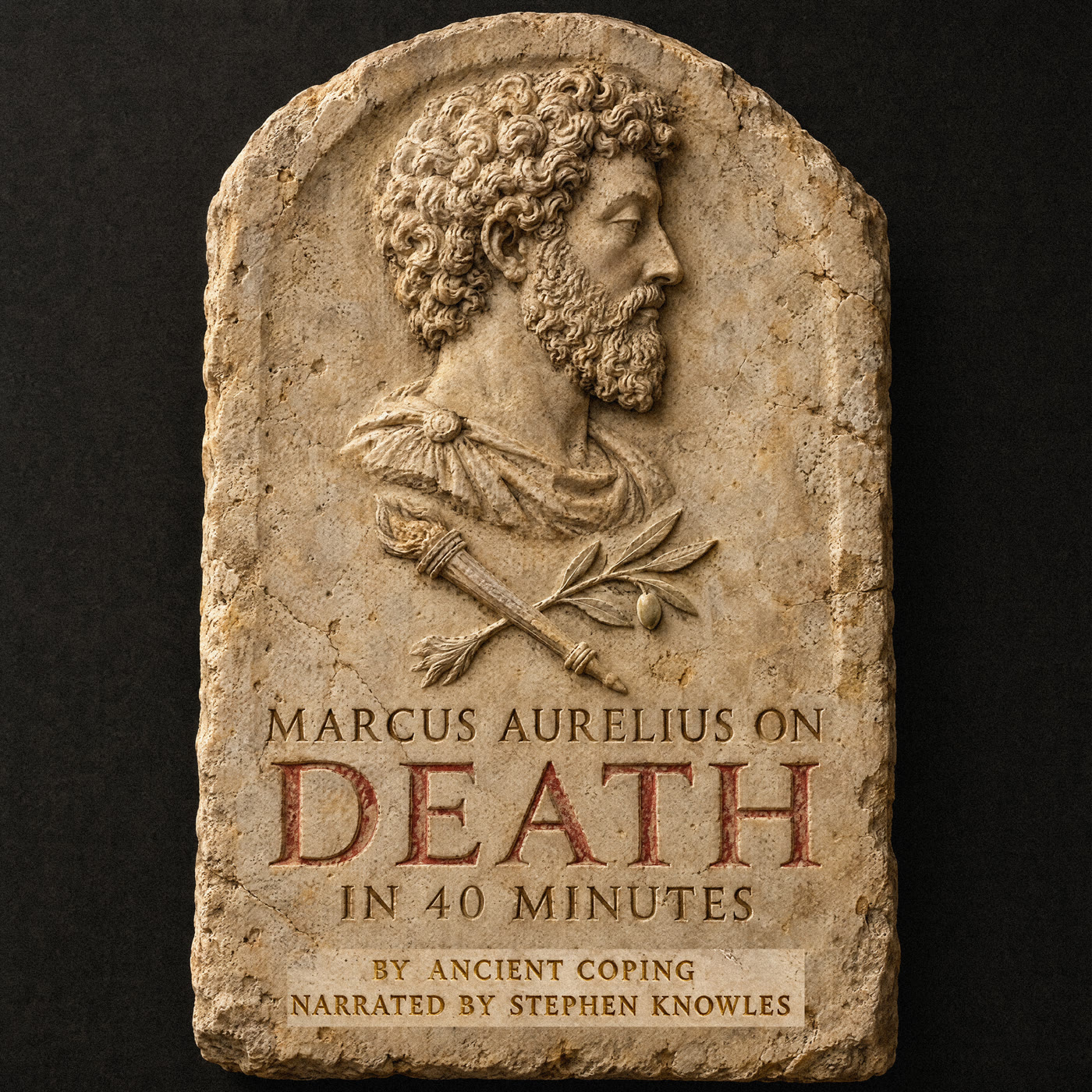
Marcus Aurelius on Death in 40 Minutes goes further than this letter. It takes you through what he thought death actually is, the full Bonus exercise, and the Long View he used to shake the need to be remembered. It covers six real moments in detail, including a parent's death, a friend's, a frightening doctor's call and the cold thought at 3 a.m. It ends with the last page of his notebook and the image of an actor leaving the stage after three acts instead of five.