It's ten past three in the morning and you're wide awake. Your heart is going a little faster than it should, and you're doing math in the dark.
The mortgage payment went up. The credit card balance has crept higher, and you stopped looking at the exact figure a while ago because it makes your stomach drop. A customer owes you money and keeps saying next week. The truck, or the water heater, or the kids' shoes will want something soon. Your wife is asleep beside you. She doesn't know how bad it is. You'll tell her when it's sorted. That has been the plan for five months.
Money stress at night feels like a verdict on you. It's closer to a fog. The Stoics lived two thousand years ago, and several of them knew real money trouble. They had a practical way of clearing it. It won't fix your balance overnight. It will change what you do about it, starting this week.
Why the number is smaller than the fear
Epictetus was born a slave and became one of the most respected teachers in Rome. In his Handbook he says, roughly, that it isn't things themselves that disturb us, but our judgments about them. A bill is a bill. I'm drowning and I'm a failure are stories added on top. The number can't say either one.
At 3 a.m. you aren't looking at your debt. You probably don't know exactly what it is. You're looking at half-remembered figures and worst-case guesses, and the guess almost always comes out bigger than the truth.
Seneca noticed the same trick in his Letters to Lucilius. As he put it, roughly, we're like children frightened by masks. Take the mask off things and look at the real face. Large or small, at least you'll know its size.
An unopened envelope can contain anything. An opened one contains only what's in it: a figure, a date, a phone number. Hard, maybe. But it has edges.
You'll know this is you if you have a drawer, a glove box or an email folder you don't open. Or if someone asks what you owe and the honest answer is that you're not sure.
So start here. Pick an evening and clear the kitchen table. Put every statement, letter and banking app on it. On one sheet of paper, write a line for every debt: who it's owed to, how much, the interest rate, the minimum payment and the due date. On the other side, list every dollar coming in and every dollar owed to you. The small ones count too.
It won't feel good. It isn't meant to. It turns fog into figures, and you can work with figures.
Try it right now. Name your three biggest debts and guess the amount of each. Whichever one you're least sure of is the first envelope you open.
Sort what's yours from what's weather
Epictetus opens the Handbook by splitting the world in two. Some things are up to us: our opinions, our choices, our effort. Some are not: our bodies, our reputation and, he says plainly, our property. In his day, property could vanish to a thief, a court or a bad harvest. Today, add an interest rate set in a meeting room you'll never enter.
He wasn't telling anyone to shrug. Once you accept that part of the money is weather, you can stop spending your strength on the weather and put it on what you can actually do.
Two voices usually fight over a man in debt. One says none of this is my fault: the rates, the economy, the clients who don't pay. So he does nothing. The other says all of it is my fault: I should have seen it coming. So he feels terrible and also does nothing. The steadier question is simpler. What is mine to move?
Go back to your sheet. Next to each line, write one action that is entirely yours. Not a hope that rates will fall. An action:
- Ask your lender what options exist before you miss a payment.
- Send the overdue invoice again, in writing, with a date.
- Cancel what you don't use.
- Stop adding new charges to the card.
Small actions count. A small step you take beats a big one you imagine.
You'll notice most of them involve a phone call, and that's where pride gets in the way. Marcus Aurelius, who was emperor when he wrote his private notebook, reminded himself, roughly, not to be ashamed of being helped. Do your duty like a soldier at a wall, he says, and if you're lame and can only climb with a comrade's hand, what of it? He wasn't talking down to anyone. He was talking to himself.
Call early, while it's still a conversation and not a crisis. I'm not a financial advisor, and this isn't advice about any loan or card. That's the point. Look for a nonprofit, independent credit counseling service where you live. They've seen worse than yours, and they won't judge you.
Don't keep your worth on the statement
It is not the man who has too little, but the man who craves more, that is poor. (Seneca, Letters to Lucilius 2)
Seneca meant that poverty is measured by wanting, not by what's in your hands. A fair warning: he was one of the richest men in Rome, so it's easy to roll your eyes. Epictetus is the better test. He owned almost nothing and was lame, and people still traveled to hear him. Nobody left thinking of him as a poor man in any way that mattered.
Today the pull looks different. A buddy posts a new truck, and you feel that sour twist. You don't know his sheet. It may be financed to the roof. You only know yours.
A man who owes money isn't a lesser man. A man who earns less this year than last isn't less of a father. When the shame comes, ask a question you can answer: are my hands honest? Am I doing honest work, keeping my word, looking after my people as well as I can with what I have? If yes, you're doing the job. The balance is weather. The hands are yours.
Your plan for this week
Five steps. None needs a good mood.
- Gather. Find every envelope, statement and app, and put them in one place. Don't judge. Just collect.
- Write the sheet. One page, every debt, every dollar coming in. Guess nothing you can look up.
- Add one action per line. Only things that are yours to do. Circle the one you've been avoiding.
- Make one call. Before you dial, write your first sentence on paper: My payments have gone up, I'm finding it hard, and I'd like to talk about my options. Take notes. Ask for anything important in writing. Book a time with a credit counselor.
- Tell one person. If you share your finances with a partner, don't wait until it's sorted. Give her the facts, what you're already doing, and what you need from her. If you live alone, pick a friend or family member you trust.
If the stress is wearing you down, with weeks of poor sleep, no appetite or no ability to function, see a doctor. If you ever feel your family would be better off without you, call or text 988 in the US, or contact emergency services, right away. Debt can be dealt with. You can't be replaced.
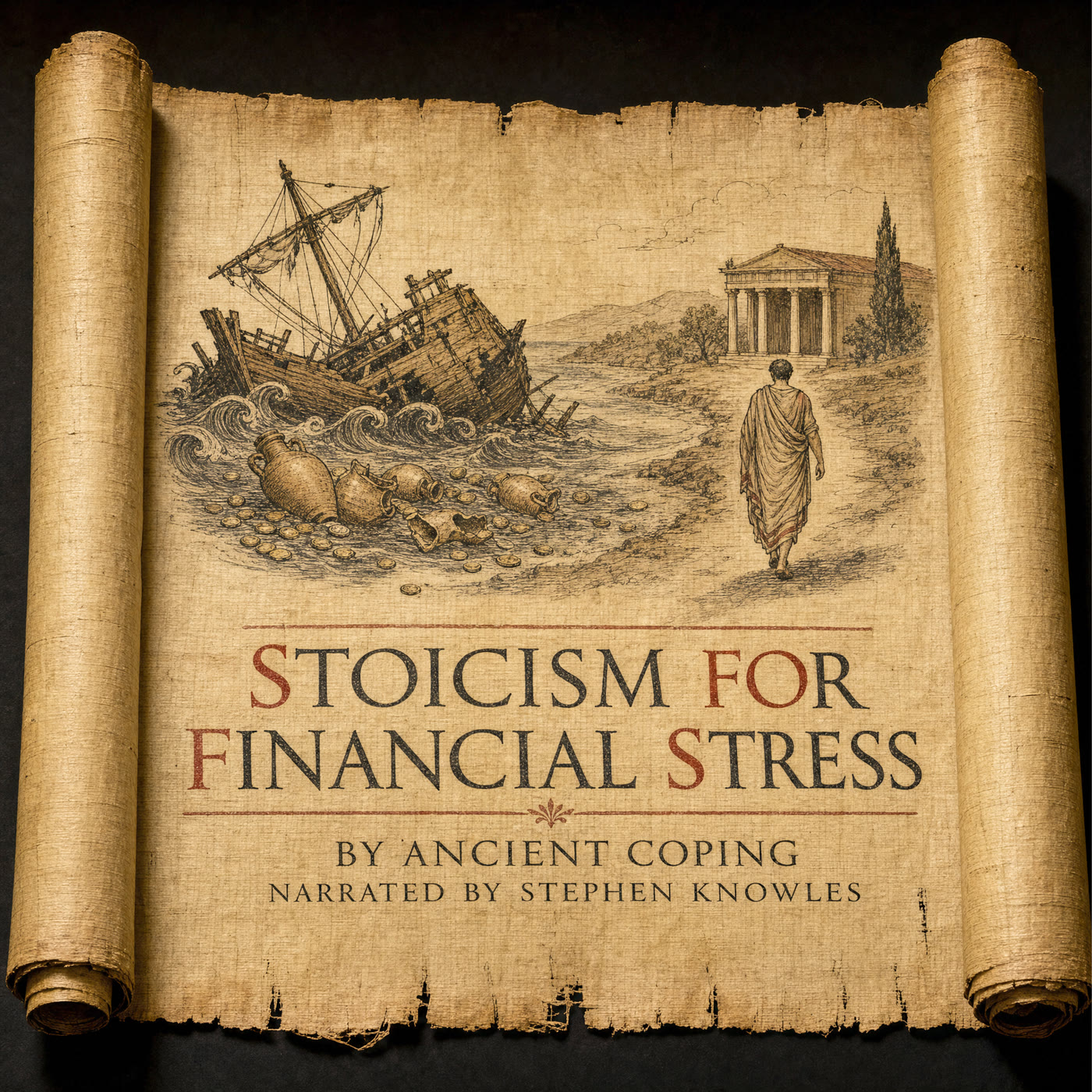
That's the first half of the work. Stoicism for Financial Stress covers the rest: how to have the harder conversation at home, what to say when your kid asks for something you can't afford, how Musonius Rufus's plain-food frugality can build a small cushion against the next surprise bill, how to handle a client who keeps saying next week, and the story of a merchant who lost everything in one afternoon at sea and later called it a good voyage.