It is 11:40 at night and you are at the kitchen table with the laptop open. The house is dark except for the screen. Upstairs, everyone you love is asleep.
Today you signed the client you have chased for six months. You posted about it. The reactions are piling up. For about nine minutes, it felt like the thing you worked for. Then it drained away, and you made tea and started thinking about the next target.
You are not broken, and you are not ungrateful. This is one of the most common patterns among driven people. The ancient Stoics saw it too, and they had a plain explanation.
Why the good feeling drains so fast
There are two reasons, and neither is a character flaw.
The goal was a stand-in. Most targets are not what we actually want. They are a roundabout way of getting something else: security, respect, or the satisfaction of doing something well. When you hit the number, the target is gone but the hunger underneath is still there. It was never fed.
The verdict came from outside. A signed contract, a promotion and a post with two hundred reactions are all reports on what other people did. They said yes. They clapped. Your good day was in their hands, so it left when their attention did.
This also explains why every finish line becomes a starting line. If the target was only a stand-in, reaching it can't settle anything. So you move the line and run again.
What Marcus Aurelius and Seneca would say
Marcus Aurelius ran the Roman Empire in the second century. He also kept a private notebook, now called the Meditations, where he talked to himself. In one passage he sorts people by where they keep their good. Roughly put: the man who loves fame keeps his good in what other people do. The man who loves pleasure keeps it in what he feels. The man with understanding keeps it in what he himself does.
In his time, that was a pointed note for an emperor. Everyone around him was ready to hand him praise, and he knew praise was weather. Today, the same warning applies to a dashboard, a follower count or a quarterly review. Each one measures other people's actions, and none of them measures yours.
Seneca was a Roman statesman and a very rich man, and his life had real contradictions. But his letters to his friend Lucilius say something useful about the empty feeling:
"It is not the man who has too little, but the man who craves more, that is poor." (Seneca, Letters to Lucilius, 2)
He was not telling Lucilius to stop wanting things. He was pointing at the craving that never settles, the kind that makes a man poor at any income. Seneca also returned several times to Alexander the Great as a warning. By his telling, Alexander had conquered much of the known world and still could not sit still in any of it.
Neither man told you to quit your job or aim lower. Marcus held himself to a harder standard, not an easier one. If your good lives in your own actions, you cannot blame luck or timing. The only question left is whether you did the work well.
A practice for this week
This takes about ten minutes a day. It uses two ideas from the book.
- Pick one goal. Choose the one you think about most. Write it down.
- Ask what you want underneath it. Write the answer. Then ask the same question of that answer. Do it three times, or until you hit something that is not a number.
- Sort what you find. It is usually one of three things: security, respect, or the wish to do something well. The first two are human needs, and there is no shame in them. The third is the only one you can feed every day without anyone's permission.
- Tonight, before you open any dashboard, write three things you did well today. Write actions, not results. "I made the call I was avoiding." "I told the truth about the missed deadline." "I prepared properly." If you catch yourself writing results, cross them out and ask what you actually did.
- Then look at the numbers. Read them as information about the world, not as a verdict on you.
- Feed one hunger directly. If you found respect underneath the goal, tell one person whose opinion matters what you are proud of. If you found security, write down what safe would actually look like. If you found the wish to do something well, spend an hour on the craft with no audience.
Expect step four to feel awkward for the first few days. That is normal. You have spent years training yourself to check the score first.
By the end of the week, notice one thing. Does a bad number still ruin a day in which you behaved well? Does a good number still rescue a day in which you did not? The answer tells you where you have been keeping your good.
If the flatness doesn't lift
A flat feeling after a win is common. But if you are exhausted most of the time, sleeping badly, drinking more to cope, or feeling numb even when things go well, that deserves more than a philosophy exercise. Those can be signs of burnout or something else worth checking. See your doctor. A counselor or therapist can help too, and many men find it useful long before anything reaches a crisis. If you ever feel you cannot go on, or have thoughts of harming yourself, contact a crisis line or emergency services where you live today. Do not carry that alone.
The empty feeling is not a reason to stop building. It is information about where you have been looking for the payoff. Marcus's answer was not to want less. It was to aim at something you can actually reach every day.
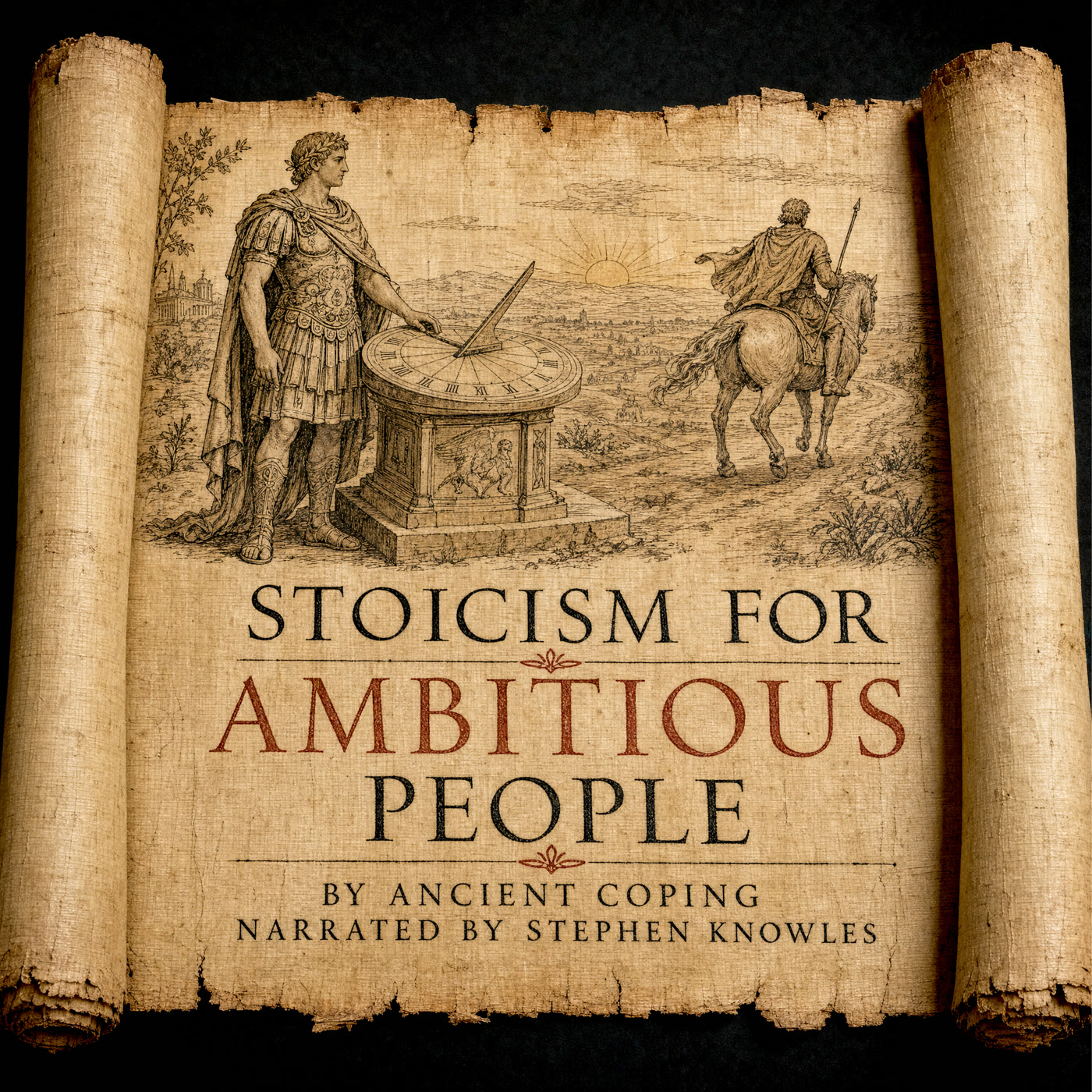
The full approach is in Stoicism for Ambitious People, a forty-minute audiobook that builds on Marcus Aurelius, Seneca, Epictetus and Musonius Rufus. Beyond the two tools above, it covers how a role can slowly change you without your noticing, how to set an "enough" line in plain numbers with your partner, how to score the other roles in your life besides the one on your business card, and the portrait of a powerful man that Marcus chose to copy. It also follows Raj, a successful agency owner on a treadmill, as he works through each of these ideas.