You pull into the driveway at 7:10 on a Friday and cut the engine. You don't get out. The car is the one you wanted three years ago. The paycheck clears on time. The fridge is full. You sit there with your phone in your hand, and a thought shows up that feels almost rude: this is it?
Nothing is wrong, and that is what bothers you. You did the things you were supposed to do. You can't explain why the good feeling never sticks.
Epicurus wouldn't be surprised. He taught in Athens around 300 BC and spent his life on this exact problem. His answer is plainer than you'd guess, and most of it costs nothing.
You are chasing the wrong kind of pleasure
Epicurus noticed that the word pleasure covers two different things.
The first is the pleasure of change. Hungry, then fed. Cold, then in a hot shower. Broke, then paid. A new truck, a win, a compliment, a drink. It comes in a rush, and it is real. But it needs a lack to start from, and it fades fast. The fifth bite is never the first. The new car is just your car by next month.
The second is the pleasure of being in a good state. Your body isn't hurting. Your mind isn't chewing on something. You have nothing to fear and nothing to chase. It is quiet, so it is easy to miss. Epicurus thought it was the higher kind. In his letter to Menoeceus, he said the goal was the absence of pain in the body and trouble in the mind. He added that feasts and nonstop partying don't build a good life. His critics accused him of preaching indulgence. He was saying nearly the opposite.
The trap is that the rush wears off, so the next one has to be bigger. Researchers call this adaptation. You can feel it in your own life. The bigger apartment, the better truck, and the pricier trip all turn into normal. Epicurus put it in one line:
Nothing is sufficient for him to whom what is sufficient seems too little. (Epicurus, Vatican Sayings, 68)
In his day that was aimed at men who treated wealth and reputation as a ladder with no top rung. Today it describes the guy checking his salary against his coworker's, or his brokerage app for the fourth time before lunch.
The chase also tends to eat the calm it was supposed to buy. The overtime costs you evenings. The drinks that were supposed to help you unwind cost you sleep. You end up trading a lot of the steady kind for a little of the quick kind.
Sort your wants into three piles
This is the most useful tool Epicurus left. He sorted desires into three kinds.
- Natural and necessary. Food, shelter, sleep, health, friends, peace of mind. These are easy to satisfy, and they stop asking once you have met them.
- Natural but not necessary. A nicer house, a better bottle of wine, a particular truck. These are fine to enjoy when they come easily. They aren't worth a heavy price to chase.
- Neither natural nor necessary. Fame, status, being envied, earning more than your brother-in-law. Epicurus said these come from empty opinion. They have no natural limit, so nothing you get will ever satisfy them.
Seneca, a Roman Stoic whose school rivaled Epicurus's, quoted him often. In his letters he passes on the advice, roughly, that if you want to make a man rich, you shouldn't add to his money. You should subtract from his wants. Seneca didn't agree with Epicurus on everything, but he thought a good idea belonged to everyone.
Now apply it to your own life. Say you want a bigger salary. If you can't cover your family's needs, that want is natural and necessary. Once you can, ask honestly what the extra is for. Say you want a promotion. If it means better work, fine. If it means a better title, that is probably empty opinion.
Most men who do this honestly find that much of their stress sits in the third pile. They also find that most of what would make them content sits in the first pile, and costs very little.
Epicurus lived this way. He ate bread and water most days, and he once asked a friend to send him a little pot of cheese so he could have a feast whenever he liked. He wasn't punishing himself. He was keeping his appetite honest, so that small things tasted like something.
The part most men let slip
Epicurus ranked one thing above comfort, health, and money. He said that of everything wisdom provides for a happy life, friendship is by far the greatest. His point wasn't only that friends are fun. It was that knowing people would come if you called takes a huge weight off your mind.
Seneca passed on one of his rules. Before you decide what to eat and drink, think about who you will eat and drink with. Eating alone, in his view, is closer to how a wolf lives than a man.
A lot of men around forty look up and find coworkers, family, and nobody they would call at 11 p.m. Nobody planned it. Jobs, moves, and kids thinned things out. Epicurus would say this matters more than the car. He would also say it is fixable, but only on purpose.
A practice for this week
Five steps. None of them costs money.
- Find a content moment. Think of a time you felt truly at ease. Not excited. Easy. Write down what was in it. It's usually very little: a comfortable body, people you liked, nothing wrong.
- Write twenty wants. Anything you want or are working toward. Sort each one into the three piles.
- Pick one from the third pile. Ask what it is costing you in sleep, time, money, or friends. Decide how much is enough, and write the number down.
- Run the Morning After Test once. Before one pleasure, such as the third drink, the late scroll, or the impulse purchase, ask what it will cost you tomorrow. Epicurus said that not every pleasure should be taken, and not every pain should be avoided. Count what comes after.
- Share one meal. Text one friend you like. Something plain: a sandwich, a curry, a burger. Set a repeat date before you leave. You make the first move, because most men are waiting for someone else to.
One honest note. If you have felt flat for weeks, lost interest in almost everything, are drinking to feel anything at all, or have thoughts of hurting yourself, this is more than a philosophy problem. Please see a doctor and tell someone close to you. Don't carry that alone.
Otherwise, the answer to the question is simple. You may be chasing the rush while the calm goes unnoticed. Sort the wants, find the friend, and spend one evening with nothing wrong. Then see what you notice.
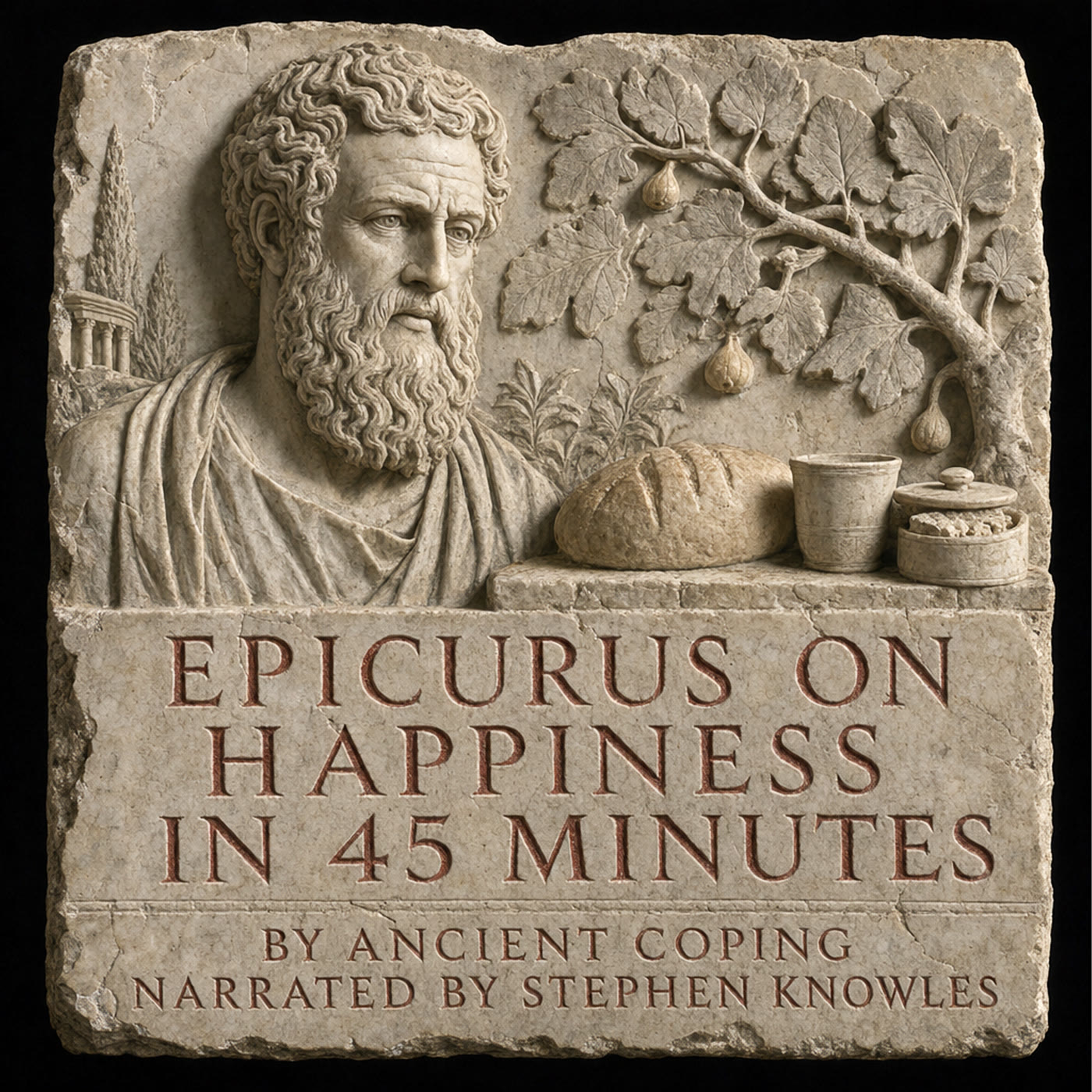
That is only a start on Epicurus. Epicurus on Happiness in 45 Minutes goes further. It covers his four-part cure for anxiety and the fear of death. It includes The Pot of Cheese, a simple-living practice that makes ordinary pleasures taste good again. It adds a set of ready-to-use lines for starting with friends again, a way to handle common situations like overwork, drinking, and money fear, and the letter he wrote on the last day of his life, in terrible pain, which he called the happiest of his life. It ends with a full seven-day plan.