It is late. The house is quiet, and you are on your back with your phone held over your face. A guy you went to school with posted a photo from a boat. Someone from your old job made partner. A third guy is thanking everyone for helping him buy a house with a yard the size of a park.
You put the phone face down on your chest. And the question comes up again, the one that has been coming up all year. Why me?
You did the work. You paid the bills. You kept your head down. It still went wrong.
This is not a new feeling. Three men who lived almost two thousand years ago wrote about it directly, and their answers are more useful than the usual advice to count your blessings. None of them say nothing bad happened to you. They say the question is the wrong tool for the job.
Why it feels like a verdict
Seneca was a Roman statesman and writer. A friend of his, Lucilius, asked a question people still ask: if the world has any order to it, why do bad things happen to good men? Seneca answered with a short essay, On Providence. Keep in mind he wrote from a comfortable life close to power, so weigh his words with that in mind.
His answer, roughly, goes like this. A general does not send his weakest soldiers to the most dangerous post. He sends the ones he trusts. The hard post is not a punishment. It is a sign of confidence.
You don't have to believe anyone posted you anywhere. That is your call. But the question works either way: If I had been put here on purpose, by someone who trusted me, what would they expect me to do this week?
In the book, a man named Simon is forty-six. He was passed over for a promotion he earned. It went to a younger guy with better connections. When he tried this question, the answer was plainer than he liked. They would expect him to stop sulking in meetings. They would expect him to do his job well, under a man fifteen years younger, without making that man's life miserable.
He didn't enjoy the answer. But for the first time in months, he knew what his job was.
Notice what changed. He stopped being someone things happen to. He became someone with a post to hold.
Split the problem from the why
Marcus Aurelius was emperor of Rome. He kept a private notebook, now called the Meditations, never meant for anyone else. In one passage, in one translation, he says: "A cucumber is bitter—Throw it away.—There are briers in the road—Turn aside from them.—This is enough. Do not add, And why were such things made in the world?"
He doesn't say the cucumber is secretly sweet. He just says deal with it and skip the second question.
Try this on whatever is bothering you most. Write two lines:
- The cucumber: the one practical thing in front of me.
- The why: the question of why the world is like this, and why it came to me.
Then work on the first line only.
Simon's cucumber was an uninsured driver who rear-ended him at a red light. He spent weeks on the why. Why him, why that road, why does the system let people drive uninsured. He told the story at work, at the bar, to his brother. Each time he got angry again. Meanwhile the claim form sat unfinished in a drawer.
When he split it, the cucumber was small and dull. Fill out the form. Call his own insurer and ask what the policy covered. Ask whether there was a fund for victims of uninsured drivers. Get a repair estimate. It took one Saturday morning and a lot of hold music. By lunch he had a reference number and a date. It wasn't justice. But a surprising amount of the anger went with it.
Is it weather, or is it a wrong?
Here is where people get the Stoics wrong. They hear all this and think the lesson is to swallow everything. It isn't.
For the Stoics, justice was one of the main virtues. It meant something you practiced, not something the world owed you. Marcus put it this way: "That which is not good for the swarm, neither is it good for the bee." If something is truly unjust in your workplace, your family, your town, you have a part in dealing with it.
So sort what happened to you into two piles:
- Weather. Illness, accidents, the economy, where and to whom you were born. Nobody did it to you on purpose. Use the cucumber move. Handle the practical part, drop the why.
- A wrong. A person or an institution broke a rule, a promise, or basic decency. You were lied to, cheated, passed over by a process that was skipped. Act on it calmly, with dates and evidence, without turning it into a war over your pride.
Many things are a mix. Separate the strands and act only on the part that is a wrong.
Simon had always told his promotion story as pure weather: it's who you know. When he wrote it out, he saw that the job had never been posted internally. Two people senior to the winner never heard it existed. That was a process problem, not luck. He asked for a meeting with HR. He didn't complain about the other guy. He asked how internal roles were supposed to be filled, and he brought dates. He did not raise his voice.
He didn't get the job. But six weeks later the company changed its policy, and the next role was posted to everyone.
While he had the notepad out, he also asked whether he had been fair to anyone else. He had been half ignoring a junior coworker all year because she reminded him of the guy who got the job. That was a wrong too, and it was his. He took her to lunch.
Stop watching other people's plates
Epictetus was born a slave in what is now Turkey. He was lame, according to ancient accounts, and was later freed and became a teacher. If anyone had grounds to call life unfair, he did. His image for it was a dinner party.
Remember that in life you ought to behave as at a banquet. Suppose that something is carried round and is opposite to you. Stretch out your hand and take a portion with decency. (Epictetus, Handbook 15)
In his day, a banquet meant dishes passed around a table. You take a modest portion as it reaches you. If it passes you by, you don't grab. If it hasn't reached you yet, you don't lean down the table toward it. You didn't cook the meal or pick the seats. That was his point about life.
Today the dish is on your phone. The boat, the partnership, the yard. Epictetus would not tell you those men don't have good things. He would ask what is on your plate, and whether you are eating it or watching the other plates go by.
Simon's mother left the family house to his brother, who had driven her to appointments for six years while Simon lived three hours away. It was fair, and it still stung. When he made himself list his plate, it was a marriage that survived hard years, a son who still called, a job, decent health, and enough money from his mother to clear his mortgage. He hadn't even told his wife how much that last one meant. He was too busy watching the house.
Your week
You can do this in seven days, a few minutes at a time.
- Day one. Write down the three things from this year that feel most unfair. Just name them.
- Day two. Next to each, write weather or wrong. If it's both, split it.
- Day three. Pick one wrong and take one calm, practical step. A letter, a call, a form. Write down dates and names.
- Day four. Pick one piece of weather. Write the cucumber in one sentence. Do the first small thing about it.
- Day five. Every time you catch yourself comparing, say: that's the window, not the stockroom. Charge your phone in the kitchen tonight, not by the bed.
- Day six. List what is on your plate. Tell one person you love about one item on it.
- Day seven. Ask what a trusted man would be expected to do with your hard post this week. Do the first piece of it.
One serious note. A run of bad luck can wear a man down more than he notices. If the bitterness has turned into a heaviness you can't shake, if you aren't sleeping, are drinking more than you should, or have thoughts of harming yourself or anyone else, talk to your doctor or a counselor. If you are in crisis, call or text 988 in the US, or contact emergency services, today. Don't carry that one alone. If money is part of the pressure, free debt counseling exists. If you were truly wronged at work, a legal aid office or a union can help you push back properly.
These are old tools, and they don't ask you to pretend. They ask you to pick the right fight, and to put down the one you can't win by asking why.
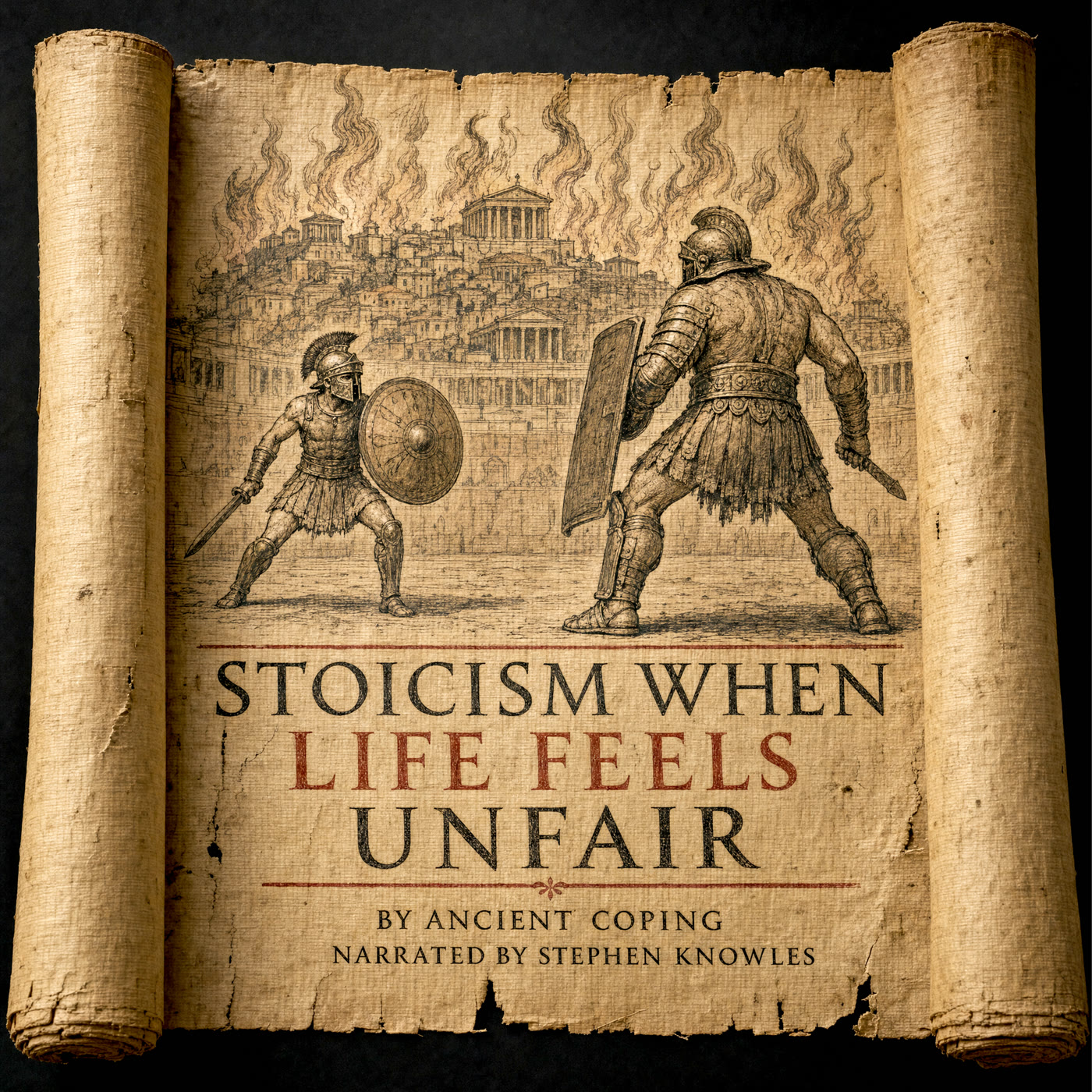
Stoicism When Life Feels Unfair takes this much further across about forty minutes. It covers the gladiator's idea of a real insult in Seneca's essay, how to treat a bad year as a test instead of a verdict, and the letter Seneca wrote to a friend whose city burned in a single night, along with what happened to that city afterward. It also follows Simon through his whole year, and it lays out six more situations you will likely recognize, from the 2 a.m. scroll to the call with a company that won't admit its mistake.