It's Tuesday. The alarm goes off at 6:45 and you lie there looking at the ceiling. You don't feel dread. You don't feel excited. You feel nothing much at all. You get up, drive the same road, park in the same spot, and somewhere between the car and your desk a question floats up: Is this it?
At night the kids go to bed and you end up on the couch with your phone. You watch a stranger rebuild a boat. You open a beer, and later another. It's midnight before you look at the clock.
Nothing is wrong. That's the part that bothers you. You did what you were supposed to do, and you still feel like you've lost the road without ever leaving it.
You are not the first man to feel this.
You're not broken. You're seasick on land.
Around two thousand years ago, a young Roman named Serenus wrote to his friend Seneca. Serenus was successful and comfortable. He was also uneasy, and he couldn't say why.
Seneca opens his essay On Tranquillity of Mind with the letter. Whether Serenus wrote those exact words or Seneca shaped them is uncertain. Either way, the description is sharp. Roughly, Serenus said he wasn't sick and he wasn't well. He wanted a simple life, then saw a nice house and wanted that instead. He'd commit to something useful, then one small setback made him want to retreat. He compared himself to a man who is seasick, but not at sea.
Seasick on land. Nothing is crashing, and you still feel a little off all the time.
Notice what Serenus did right. He didn't call his life a disaster, and he didn't say "I'm fine." He told the truth about the in-between state, and that was where his recovery started.
Most of us have two settings: fine, or on fire. When nothing is on fire, we keep going, and the seasickness gets a little worse every month.
Why changing the scenery doesn't fix it
Seneca's answer wasn't gentle. He said Serenus was far from alone. He described people who start plan after plan and finish none, who feel a weariness at the sameness of things, and who try to cure it by moving. They travel from the coast to the city to the countryside. Each new place promises relief, and each time the restlessness comes along.
He made the same point in one of his letters to Lucilius, when a friend wanted to travel his troubles away:
"Animum debes mutare, non caelum." (Seneca, Letters to Lucilius, 28)
Roughly: it's your mind you need to change, not your sky.
In his time, that meant the boat trip and the villa by the sea. Now it looks different, but it's the same move:
- A browser full of tabs for watches you won't buy.
- A sudden urge to buy a motorcycle, move across the country, or start over.
- One more video, one more drink, one more scroll.
There are two ways to read the gray feeling. The first says your life is boring, so change the job, the car, the house. The second says you've stopped doing anything that asks something of you. Your effort is unspent, your attention is scattered, and you keep trying to fill with entertainment a gap that only action can fill.
The first voice is louder. The second is usually closer to right.
Who you are is more than one job
Epictetus, the former slave who became a teacher, had a habit with confused students. He didn't hand them rules. He told them, in effect, to consider who they were.
In the Discourses, as he puts it, roughly: you are a human being first. You are also a son, which means something. You may be a brother, a father, a citizen. Each of those names comes with duties, so if you know what you are, you have a fair idea of what to do.
Here's what often happens to men in their thirties and forties. Those roles get squeezed down to one: provider. You work, the money goes in, the house runs. It's a heavy role and a constant one, and almost invisible from the inside. Nobody thanks you for the mortgage payment. When the job itself doesn't mean much to you, you spend most of your waking hours on something that feels both enormous and empty.
Then the hollow role starts to feel like a hollow man. You aren't hollow. You've just forgotten the other names.
A practice for this week
This takes about twenty minutes, spread over a few days. You only need a pen and an envelope.
- Check for fire. Ask yourself: am I in actual danger? Health, safety, money, someone I love? If yes, deal with that first. If no, you're dealing with drift, and the rest applies.
- Name the feeling. Not the story about it, the feeling. Flat? Restless? Bored? Empty? Pick one word and write it down.
- Find solid ground. Ask yourself when you last felt steady and present. What were you doing, and who was there? Don't rush this one. Let a real memory come.
- Draw your roles. On the envelope, write "human being" in the middle. Around it, write every role you hold: son, father, partner, brother, friend, neighbor, coworker. Skip your job title.
- Be honest about each one. Next to each role, write one line on what it asks of you, and one line on how you're doing this month.
- Pick one small duty. Choose the role you've neglected most. Name one thing it asks of you that you can do in the next 24 hours. Make it small and finishable, and put a time on it. Call your mother Thursday at seven. Answer your sister with real words. Read to your daughter tonight with your phone in another room. Text the friend you haven't seen in a year.
- Do it. Then pick the next one.
Epictetus told his students that nothing great comes all at once. Not even a fig, he said. First it flowers, then it fruits, then it ripens. Feeling lost makes you want to see the whole road before you move. You only need to see the next stone.
When it's more than drift
The Stoics weren't doctors, and this is not medical advice. Drift is different from something heavier. If the flatness has lasted for weeks, if you've lost interest in almost everything, if you're sleeping or eating badly, or if you're drinking more to get through your evenings, talk to your doctor. These things are treatable, and asking for help is part of looking after the people who count on you.
If you ever find yourself thinking about harming yourself, don't sit with it alone. Contact a crisis line or emergency services where you live, today. In the US, you can call or text 988.
One more thing you can do is say it out loud to someone. "I don't know exactly, I feel a bit lost, and I'm working on it" is a complete sentence. Serenus said something like it to a friend, and it's where his recovery started.
If you wake up some Tuesday feeling gray, that doesn't prove you took a wrong turn. Often it means you've outgrown the way you were living, and something in you is asking for more. Serenus was capable and successful, and he felt exactly this way. So have a lot of men since.
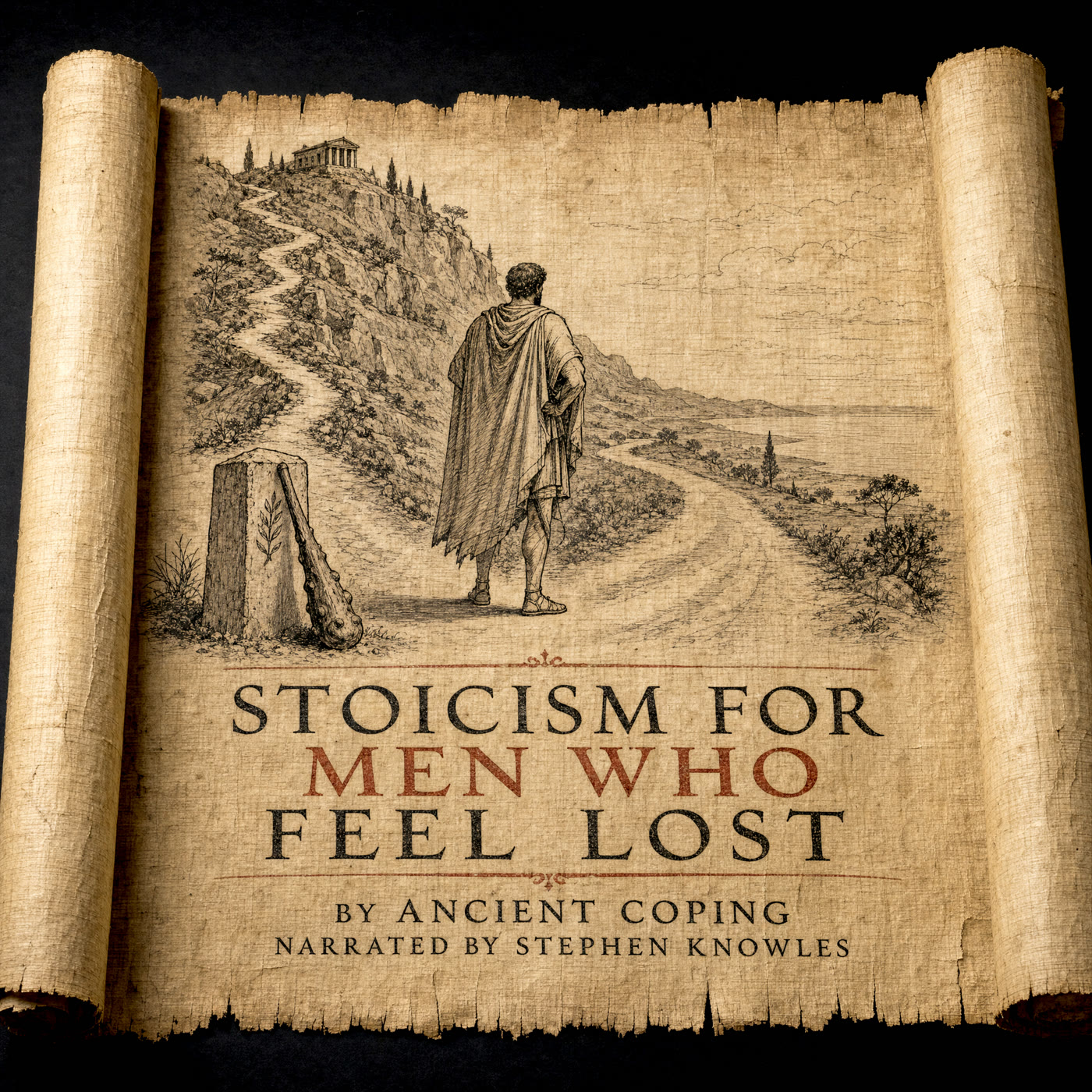
Stoicism for Men Who Feel Lost takes this much further, in about forty minutes. It follows one ordinary man through a year of drift and shows how he turned it around. It adds a way to track the automatic moments when you reach for the phone or the drink, a way to find what absorbs you so completely you forget lunch, and a daily method for the choice between the easy road and the harder one. It also tells the old story of Hercules at the crossroads, and why the Stoics took him for a hero. If any of this sounded like your Tuesday, it's written for you.