It's Sunday night, a little before ten. The dishwasher is running and your phone is in your hand. Somewhere in the last hour you stopped reading whatever was on the screen and just kept scrolling. Tomorrow starts early.
You try to say what the weekend was. Errands. Your kid's game, where you answered emails on the sideline. A lunch where you were thinking about Monday. It wasn't a bad weekend. You just can't point to any part of it and say, that was mine.
This feeling is old. Around the year 49, a Roman named Seneca wrote about it to a relative who ran the grain supply for a city of a million people. That man was busy, reliable and worn out. The essay is On the Shortness of Life, and it is still uncomfortably accurate.
The problem isn't how much time you have
Seneca opens by turning down the usual complaint. People say life is short, as if that settled things. He says it doesn't.
It is not that we have a short space of time, but that we waste much of it. (Seneca, On the Shortness of Life)
That's from the old Aubrey Stewart translation. In his day, "waste" didn't mean lying around. It meant handing your days to things that were never yours: other people's demands, ambition that depends on being seen, distraction, and waiting for the real part of life to begin.
He draws a distinction that is easy to remember. Some of your time is lived, and the rest is only passed. He gives a picture. A man leaves harbor and gets tossed around by a storm for days, then ends up near where he started. You wouldn't say he made a long voyage. You'd say he was tossed about a lot.
Seneca's most surprising claim is about the busy. We assume the busiest man is getting the most from his time. Seneca says he's the one who has given his time away. His mind is pulled in every direction, so he takes nothing in deeply. He can't enjoy the past, because he wasn't really there for it. He doesn't hold the present, because he's preparing for the next thing.
Seneca was not a monk. He was a wealthy man who spent years close to power, and he admitted nothing about this was easy. He stayed at court for another thirteen years after writing the essay. So when he says it's hard to stop, he's speaking from experience.
Why it feels like "not yet"
If the problem is this plain, why does it last for decades? Seneca's answer is that we act as if we'll live forever. As he puts it, roughly, we are mortals in everything we fear and immortals in everything we want. You buckle your seatbelt and get the oil changed. But the guitar, the trip, the long talk with your father go on a list marked "someday," as if the supply were endless.
He calls the habit of postponing the biggest drain on life. It takes each day away by promising a better one. It also cheats you twice. You miss the day you're in, and you never build a past you can enjoy later. An evening you were really present for stays yours. An evening spent in the same room on your phone leaves nothing behind.
One warning before the practice, because it matters. Seneca is not telling you to cram more into your day. Turning every hour into a project is the same disease in a new outfit. A long lunch with an old friend where nothing gets done is exactly what he'd call time well spent. The aim is to live more of your life. It isn't to do more with it.
Do this week: a seven-day reset
Seneca does something unusual in the essay. He imagines sitting an old man down and doing his accounts, like an accountant. How much went to creditors, to duties, to quarrels, to things you did without noticing? Do the same for one week of your own.
- Count the hours. A week has 168. Subtract sleep (about 50), work including commute and the thinking you do about it at home, and the necessary stuff: cooking, chores, getting kids where they need to be. What's left is your discretionary time, often 30 to 40 hours.
- Find the lived ones. Go through last week's leftover hours. Count only those where you chose the activity and your attention was actually on it. A real conversation counts. So does a walk, a project, or an hour on the floor with your kid. Write the number down. Don't be surprised if it's small. The point is a number, not guilt.
- Name the thefts. Where did the rest go? Seneca's point is that it's rarely one big theft. It's ten minutes here, a favor there, a meeting that could have been a message, an hour of scrolling when you were too tired to do anything else. Name the three biggest.
- Date your someday list. Write down what you're "going to do one day." For each item, either put a date on it within 30 days, even for a small first step, or cross it out and admit you won't. "When things calm down" is not a date. Ask yourself honestly whether things have ever calmed down in the last ten years.
- Protect one real hour. Pick it in the morning. Put the phone in another room. Be entirely there.
- Close the day. In bed, Seneca borrowed a habit from a rich man who staged a mock funeral every night. Seneca used it differently, as a quiet review: "let us go to our sleep with joy and gladness; let us say: I have lived; the course which Fortune set for me Is finished." (Letter 12, Gummere translation). Ask whether any part of today was truly yours. If yes, say it. If no, don't beat yourself up. Just decide what tomorrow's one real hour will be.
- Count again. At the end of the week, repeat step 2 and compare. If last week's number was four, you don't need a new life. You need six.
Benjamin Franklin, a famously busy printer and public man, kept a similar habit. He wrote that he began each day by asking, "What good shall I do this day?" and ended it by asking, "What good have I done to-day?" His questions are about doing good, and Seneca's are about presence. But the instinct is the same: look at the day before it's gone. Franklin also owned slaves for much of his life, so take his daily habit and leave his blind spots.
Don't make it a crusade
Don't quit on Monday or announce to your family that everything will change. Seneca told his friend to withdraw from his post, not to bolt from it. Change one evening a week, then a second.
Don't sink into regret over the years behind you either. That's one more way of missing the present. The audit exists to wake you up, and you've learned what it had to tell you. What's left is today.
One more thing. This letter is about the ordinary drift of a busy life. If what you feel is heavier than that, if nothing gives you pleasure, the days seem pointless, or you've thought your life might be better ended, that isn't a time-management problem. It can be depression, which is an illness and treatable. Please see a doctor and tell someone close to you today. If you're in immediate distress, call a crisis line or your local emergency number.
Seneca wrote to a tired man at a desk who was good at his job and hadn't had a day to himself in years. He wasn't asking him to do less for the world. He was asking him to keep some of his life for himself while there was still time.
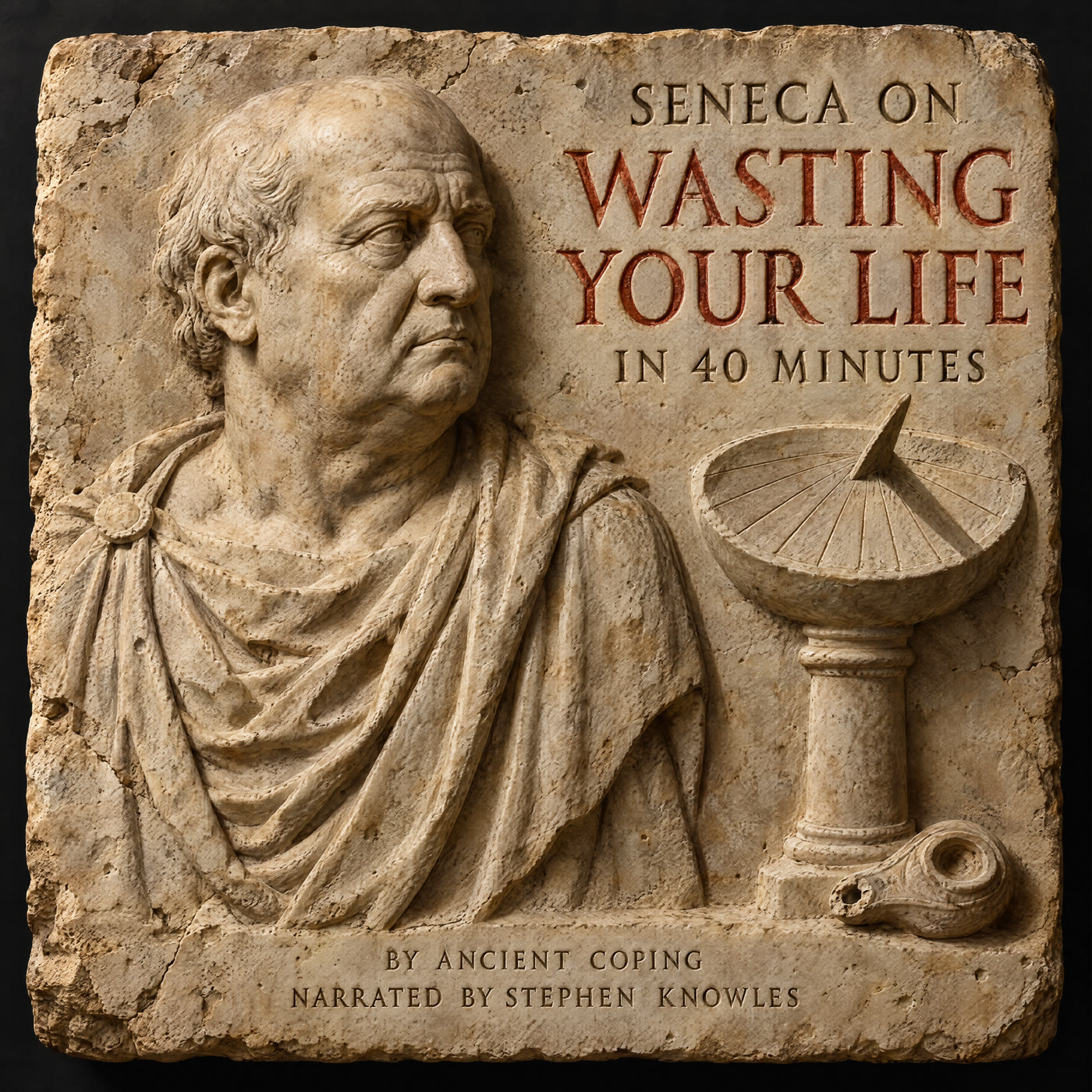
The full audiobook, Seneca on Wasting Your Life in 40 Minutes, goes further than this letter. It walks through why the busy are often the least alive, a way to guard your time from other people's demands, and what to do in five real situations: waiting for things to calm down, evenings lost to a screen, work that's stopped meaning anything, children growing up fast, and the fear that it's too late. It also covers the three ways men misread Seneca, and what he thought a well-used day actually looks like. It runs about forty minutes.