It is 4:50 on a Friday. A coworker sends a message to the whole team saying, politely, that the missed deadline was your group's fault. It wasn't. Heat climbs your neck. Within a minute you have typed a reply that is sharp, accurate, and copied to everyone. Your thumb is over the button.
Maybe for you it's not email. Maybe it's the truck that cuts you off, or the tone your partner used for the hundredth time. The question is the same. How do you stop losing your temper before it costs you something you can't get back?
A Roman senator named Seneca spent real effort on that question. He had lived under Caligula, an emperor whose bad moods got people killed. Later he wrote a long work, On Anger, for his older brother, who had asked him how anger can be calmed. Most of what he found still holds.
First, what you are dealing with
Seneca's opening is not flattering. Picture an angry person, he says: the red face, the clenched jaw, the shaking hands, the cracking voice. Some wise men before him, he notes, had called anger a brief madness. He agreed.
His main point is that anger hurts the person carrying it first. Think about that Friday reply. The insult cost you a moment's sting. The anger will cost you a ruined evening, a colleague who is careful around you for months, and a short temper with your kids at dinner.
He also takes on the best objection, which is that anger gives us courage and drive. His answer is that whatever anger can do, a clear head can do better. You can refuse, confront, leave, or fight without being out of your mind while you do it. Aristotle, whose followers Seneca was arguing with, did not say anger was always bad. He said the hard part is being angry at the right time, in the right amount, for the right reason. Seneca's reply is that almost nobody manages that, and the attempt usually goes wrong.
This is not advice to be passive. It is advice to be effective.
Anger comes in three moves
This is the most useful thing in Seneca's work. He noticed that anger does not arrive all at once. It comes in three movements:
- The jolt. Something happens and your body reacts. Heat, a pounding pulse, a tight chest. Seneca says this is not yet anger. It is a reflex, like flinching or shivering, and nobody can prevent it. Don't feel guilty about it.
- The judgment. Your mind takes a position: I've been wronged. They did that on purpose. They need to pay. It happens so fast that it feels like part of the jolt, but it is an opinion, and opinions can be questioned.
- The fall. Now anger has taken over. Seneca compares it to a body falling from a height, which can't stop itself halfway down.
The first move can't be stopped, and neither can the third once it begins. All your freedom lives in the second.
Epictetus, a former slave who taught in Rome a generation after Seneca, said much the same thing. Roughly, he said it isn't the person who insults you that hurts you but your belief that you've been insulted. In his time that was a claim about slaves and masters and what a free mind can refuse. Today it means the story you tell in the half second after the jolt.
Take the gray car that swerves into your lane. Your heart pounds. That part is just your body protecting you. Then comes the story: he did that on purpose, he thinks he owns the road. You have no evidence for any of it. If you sign your name under that story, the horn comes next.
"The greatest remedy for anger is delay." (Seneca, On Anger 2.29)
What to do in the moment
Seneca's best-known remedy follows from the three movements. If anger depends on a snap judgment, give the judgment time to weaken. He does not ask you to promise you will never act. He asks you not to act yet.
Here are three small tools you can use right away.
- Delay. Don't decide, send, or say anything permanent while the heat is high. The bigger the matter, the longer the wait. For a small irritation, ten slow breaths. For an email, an hour. For anything involving your marriage, your job, or your kids, a night's sleep.
- Lower your voice. Seneca says Socrates was known to speak more quietly when he was angry. Anger wants volume, speed, and a hard face, so do the opposite. Speak slower and softer. The body reports to the mind, and the mind calms down with it.
- Take a second look. In the pause, question the story. Did they mean it, or were they careless, rushed, or ignorant? Are you sure it happened the way you heard it? Have you ever done the same thing? Seneca suggests acting as the other person's lawyer for one minute. Often they have a defense.
You also need words ready, because your blood will be up. Try I need a little time before I answer that, or I'm too irritated to talk about this well, can we come back to it after dinner? These are not weak sentences. They are what it sounds like when you keep hold of the reins.
Two warnings from Seneca's own approach. Don't use calm as a weapon. The icy silence and the over-patient voice meant to make the other person look unreasonable are just anger with better manners. The test is whether you are trying to solve the problem or to win. And expect to fail sometimes. Seneca did. Measure progress in recovery time. A blowup that used to cost you a day should start to cost you an hour.
Seneca was no saint. He was a rich man who served a dangerous court and made compromises he could not defend. He wrote about anger as someone who struggled with it, and that may be why it reads as practical rather than preachy.
Your practice for this week
This takes a few minutes a day, and the first steps cost nothing.
- Days 1 and 2: just watch. Each time you feel irritation, notice the jolt in your body and tell yourself, that's the first movement. Don't try to change anything yet.
- Days 2 and 3: catch the sentence. Right after the jolt, listen for the thought that begins with he, she, or they. Write one down each day. That is your second movement.
- Day 4: find your pattern. Ask what time of day it is, what state you're in, and what kind of thing sets you off. Many people find it's late in the day, after skipping lunch, over something they assumed would go smoothly. Fix what you can. Eat lunch.
- Day 5: use the delay once on purpose. The next small annoyance gets ten slow breaths before you respond at all.
- Day 6: use the lowered voice. In one tense moment, speak slower and quieter than you want to. Watch what happens to the other person.
- Day 7: take the second look. Pick someone who irritated you this week and argue their side privately for one full minute.
Don't expect to be a different person by Sunday. Expect something smaller. Sometime soon, something will happen that would normally set you off, and you'll notice a pause. It will be half a second in which you saw the sentence forming and didn't sign it. That pause is the practice working.
One serious note. All of this is meant for ordinary anger, the kind that spoils days and strains relationships. If you have hurt someone or fear you might, if the people close to you are afraid of you, or if you are the one afraid of someone else's temper, please don't handle it with a book alone. Talk to a doctor, a therapist, or a local support service today.
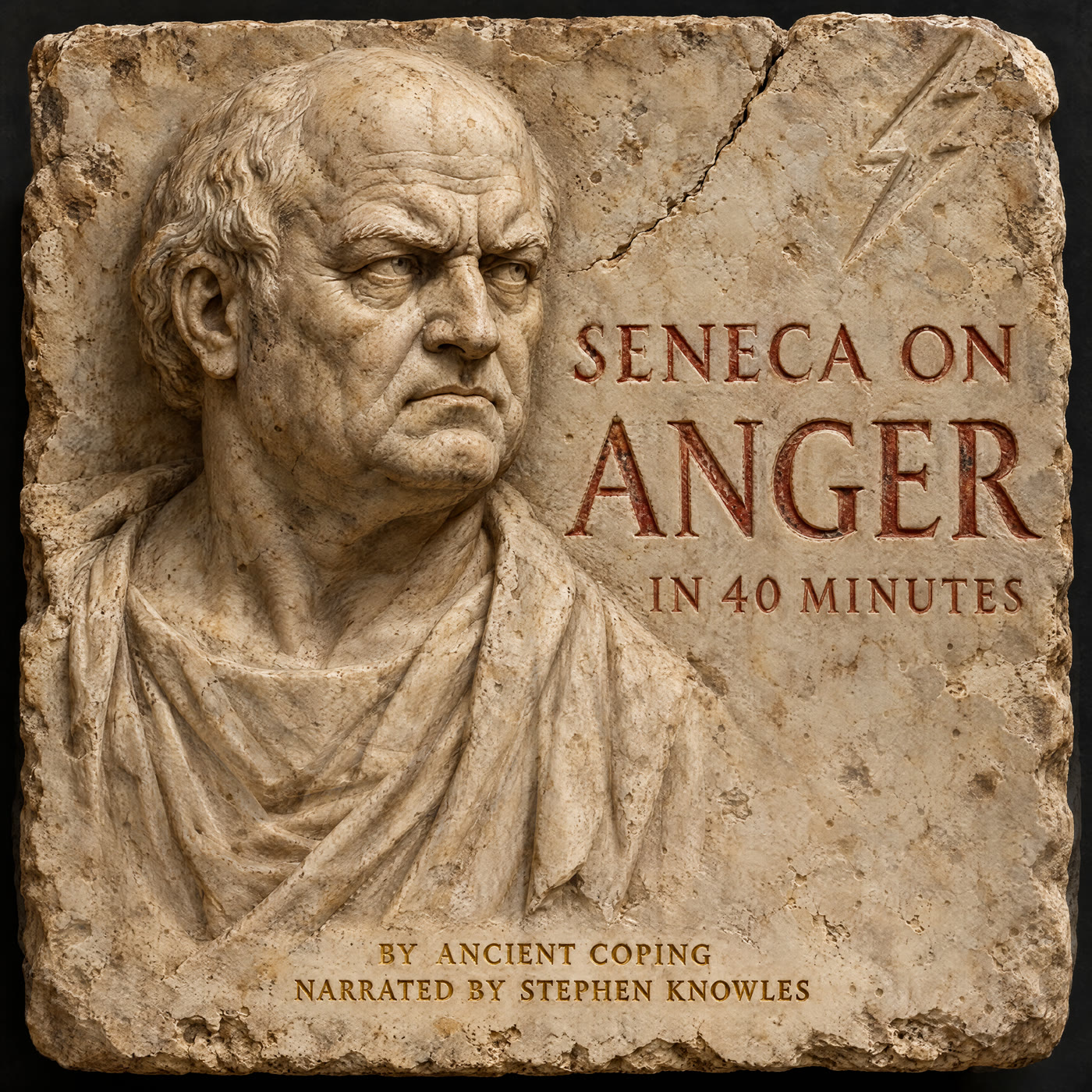
The full book goes further than this letter. Seneca on Anger in 40 Minutes lays out the strongest case for anger and why Seneca still says no, the four things that make us easy to set off (surprise, pride, comfort, and fatigue), and how to apply all of it in five real situations: on the road, in writing, with someone you love, with a child or an employee, and when someone insults you to your face. It ends with the small nightly habit Seneca used to review his own temper before sleep, which may be the most useful thing he ever wrote down.