It is Sunday night, a little before eleven. The dishwasher is running. You are on the couch with your phone, and you have opened the banking app for the third time since dinner. The number has not changed. Monday is nine hours away, and your mind has already run the meeting, the bad news, the conversation with your wife, and the part where you sell the house.
None of that has happened. You are exhausted anyway.
If you want to stop worrying about the future, start here. Worry about the future is not a character flaw. It is a mind doing a job badly. And one of the busiest men in history spent years writing notes to himself about how to do it better.
Who Marcus Aurelius was, and why he is worth hearing
In the early 170s, Marcus Aurelius, emperor of Rome, was camped on the Danube in winter. A plague was killing his people. The war on the frontier would not end. He had buried several of his children. The treasury ran so low that he sold off palace furniture to pay his soldiers. His own health was poor, and he slept badly.
In that tent, at night, he wrote short notes in Greek. They were not meant for readers. They are what we now call the Meditations. They read like a tired man reminding himself of things he keeps forgetting, which is why they still work.
He was not writing from a calm place. He was writing from inside the weight.
What worry about the future actually is
Fear answers something in front of you, like a car swerving into your lane. Anxiety answers something that is not here. The mind leaves the present, travels ahead, finds trouble, and suffers it in advance. Often it suffers it many times over.
Seneca, a Roman writing a generation before Marcus, said the same thing to a friend. In one of his letters he wrote that there are more things likely to frighten us than to crush us, and that we suffer more often in imagination than in reality. Seneca was no saint. He was a rich man who served in Nero's court, and his life was full of compromises. But on this point he was plain, and he was right.
Marcus went a step further. He told himself not to be troubled by the future, because if it came, he would meet it with the same reasoning he was using now for the present.
"Let not future things disturb thee." (Marcus Aurelius, Meditations 7.8, trans. George Long)
In his time, this was a reminder to a ruler who could not know whether the next messenger would bring word of a lost battle or a revolt. Today it means something close to home. When you picture the disaster, you picture meeting it as you are tonight: tired, in the dark, with no facts and nothing to do. That is not how you will meet it. If it comes, you will meet it in daylight, awake, with the facts in front of you. You will also have everything you have ever used to get through a bad week.
The you in the nightmare has no information. The you who shows up later will have plenty.
Planning has an end. Worrying does not.
This does not mean you should ignore tomorrow. Marcus planned campaigns, managed money, and prepared his successor. The Stoics separated planning from worrying, and so should you.
- Planning has a set time, a look at the real situation, a decision, and a next step. Then you get up from the table.
- Worrying is the same loop with no decision in it, usually at an hour when nothing can be done.
The test is simple. Is there a pen in your hand? Is anything being decided? If not, you are not preparing for the future. You are suffering it early.
Marcus also told himself, roughly, not to picture your whole life at once, and not to gather up every trouble that might come. Instead, ask of the thing in front of you what in it you cannot bear. Worry sends you the next ten years in one lump and asks you to carry it tonight. Nobody can. You are only ever asked to carry the next hour.
That is what makes the next question useful: what does this hour require of me? Not this year, just this hour. The answer is usually plain. Finish the report. Make the call. Eat something. Go to bed.
A practice for this week
You do not need the whole system for this. Try these five steps.
- Pick one worry. Choose the one that has taken up the most room in your head. Do not try to handle all of them.
- Write what has actually happened. Only the facts, as if reporting to an officer who has no patience for guessing. "My manager asked to meet at nine" is a fact. "He is going to fire me" is something you added. Most people find the facts fit in one sentence, and the rest is a long speech.
- Book one planning hour. Put it in your calendar for Saturday morning, or whenever you have quiet. Bring coffee and a sheet of paper. Write down the real numbers. If the worst happened, how long would your savings last? Who would you call first? What could you cut within a week? Write the first step on each answer.
- Give the night thoughts a place to go. Keep a pad by the bed. When a worry shows up at 2 a.m., write it in five words and tell it, "Saturday." Then go back to resting. Nothing gets solved at that hour, and most of those thoughts look smaller by breakfast.
- Ask the one-hour question. Whenever the future arrives as a crowd, ask what this hour requires. Do that one thing.
The point is not to feel calm right away. The point is to move the worry from a loop in your head to a list on paper, with a date attached. A list has edges. A loop does not.
Two cautions. First, if the news really is bad, you lose nothing by waiting for the facts. You will meet the trouble when it comes, and until then you have saved yourself the suffering. Second, this is a discipline for the ordinary weight of a demanding life. If your worry has become constant, if you are having panic attacks, if you lean on drinking to get through the evening, or if dark thoughts have started keeping you company, talk to a doctor or a therapist. Marcus kept the best physician in the empire close. There is nothing un-Stoic about getting help, and you should not carry something like that alone.
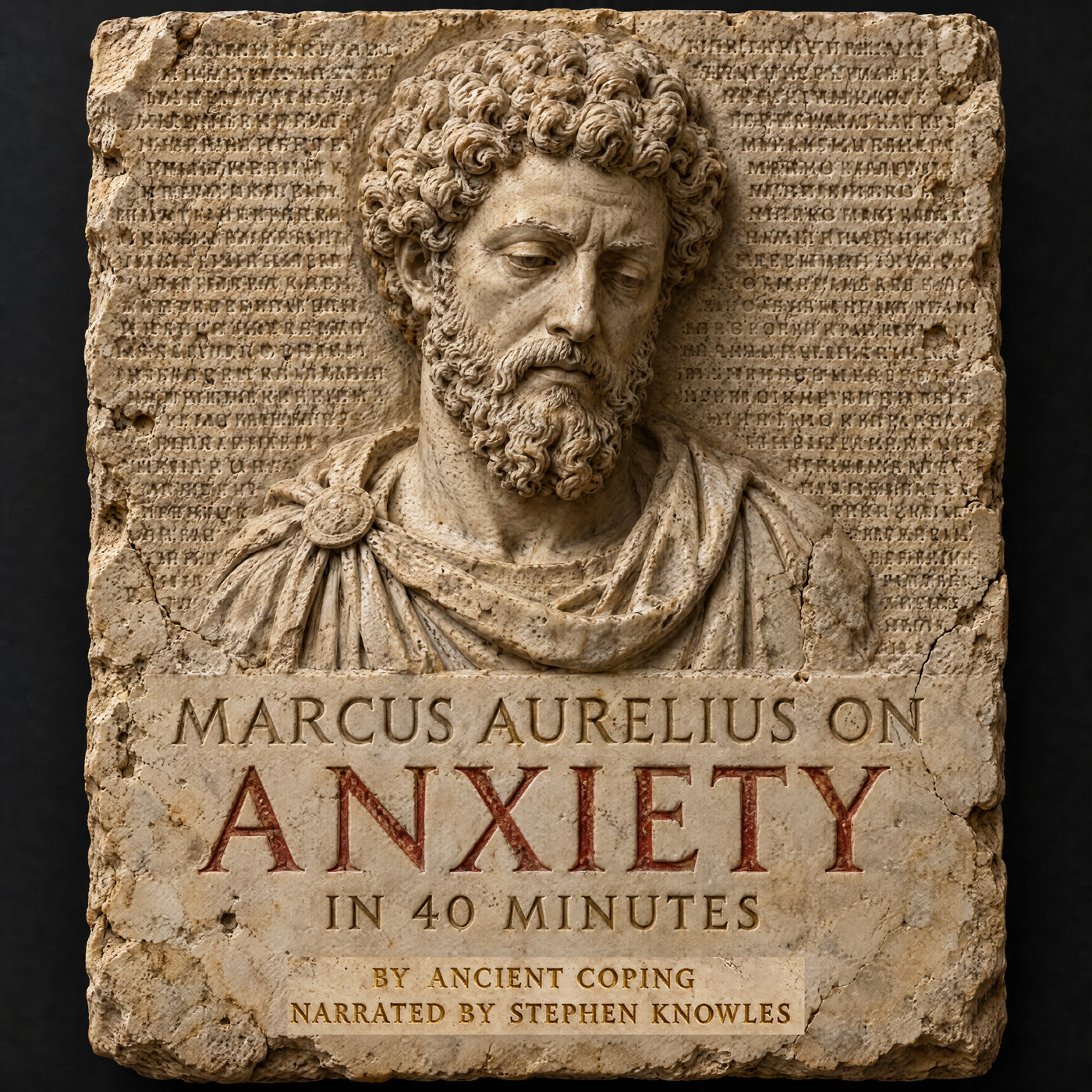
Marcus Aurelius on Anxiety in 40 Minutes goes further than this letter. It explains why Marcus believed anxiety lives in our judgments rather than in events, and it gives you his five-second habit for catching a runaway thought. It covers what is yours to control and what is not, how to handle the three a.m. hour, the health scare, the money fear, and the dread of what people think of you. It ends with the inner retreat he used when everything felt too large, and a seven-day plan to put it all to work.