It is 11:40 on a Tuesday. Your wife is asleep down the hall. You are in the bathroom with the door shut, thumbing through a dating app you downloaded "just to look." Or you are rereading a text from a woman at work that was friendlier than it needed to be. Or nothing that dramatic is happening. You are lying awake, doing math on the years left, and wondering if this is all there is.
Here is the short answer. Midlife restlessness and marriage trouble overlap, but they are not the same thing. Sometimes the marriage really has gone cold. Often it is just where your restlessness lands first. You can tell which by looking at yourself honestly. Then you tell your wife what you found, in plain words, before you do anything you can't undo.
Is it the marriage, or is it me?
"Midlife crisis" is not a medical diagnosis. It is a name for a stretch of questioning that hits many men in their 40s and 50s. The kids need you differently, your parents are aging, and your career has plateaued or cost more than it paid. Your wife is the person closest to all of it, so she takes the blame.
Three checks can help you sort it out.
- The different-life test. Imagine the restlessness gone. You have the new job, the new city, the money. Is she in that picture? If she is, the trouble is mostly in you. If every version of the better life has her missing, take that seriously. It may mean the marriage needs real repair, or that part of you has already left.
- Specific or vague? Marriage problems have names: years of the same unresolved fight, no affection, contempt, one of you carrying everything. A problem in you tends to feel vague. You are flat, irritable, or bored, and it sticks to whatever is nearest.
- Where did the resentment start? Resentment is usually old and unsaid. Ask what you never told her, or never asked for. Look at your own part too. Stored-up silence is hard on a marriage whoever kept it.
One more thing. Distance in bed is rarely just about her or just about you. Stress, poor sleep, drinking, health, and unspoken anger all feed it. If your drive or your mood has dropped, see a doctor. That is not a detour from the marriage question. It is part of answering it.
The honest answer is often both. You are restless, and some things between you went unattended for years. That is more fixable than it feels at midnight.
The affair fantasy, honestly
Nobody is going to lecture you here. Fantasizing about someone new is common, and having the thought is not a crime. It is worth asking what it is made of.
Usually it is not about her, whoever she is. It is the wish to be wanted by someone who doesn't see you as the provider, the dad, the guy who handles the gutters. It is the wish to feel alive. That wish is real, and you should take it seriously. But a dating app or a flirtation delivers a feeling, and the feeling comes from newness and secrecy. Neither survives an ordinary Tuesday kitchen. Give it two years, and you are back to the same questions with a different person.
Seneca made a version of this point in Letter 28. A friend had been traveling to shake off his gloom, and it wasn't working. Seneca's reply, roughly, was that he kept taking himself along. A new partner is a trip. It can be a good trip, but you pack yourself either way.
Emotional affairs deserve a straight word. No sex is involved, so men tell themselves nothing is happening. Look for these signs:
- You tell her things you don't tell your wife.
- You delete messages or turn your phone face down.
- You would write differently if your wife were reading over your shoulder.
- You are looking forward to the next message more than to going home.
If that is you, you don't need a verdict on your character. You need to see what is happening and decide what to do about it.
If it has already gone further, the hiding does more damage than most things. End it, or at least end the secrecy. Telling her is hard and may hurt badly. But rebuilding trust can't start while she is living in a version of events that isn't true. If it comes to that, get a counselor involved early. Be ready for her to set the pace, and for it to take a long time. No one can promise how it will turn out.
Before you decide anything, talk
Most men at this point decide alone. They decide to leave, or to stay and say nothing. Either way, the one person with the biggest stake hasn't been asked. Seneca, writing to his friend, put the standard in one line.
Let us say what we feel, and feel what we say; let speech harmonize with life. (Seneca, Letters to Lucilius 75)
He meant that your words should carry what you actually think, and not a polished or hinting version of it. Today, that looks like telling your wife what is going on with you before you've settled on a plan.
Here is a way to start.
- Pick the hour. Not in bed, not after a fight, not after drinks. Give her a little warning: "I'd like to talk about us properly. Could we have an hour Saturday morning?"
- Say the true thing early. For example: "I've been restless for a long time, and I've been taking it out on us. I don't know yet what it means." Then stop talking and let her answer.
- Own your part first. Skip the list of what she did wrong. Talk about what you miss and what you've been doing.
- Don't hand her a decision. Don't say "I need space" unless you mean it. Don't drop "I'm not sure I love you" as a test. If that is what you honestly feel, say so, but not as a threat or a bargaining chip.
- Ask a real question and listen. "What have the last few years been like for you?" Be ready for the answer to sting.
If you can't find the words, the free What to Say page has plain lines for hard conversations.
Couples counseling works best early, as a place to say the hard things with someone steady in the room, not as a last resort. If you do separate, do it with a plan: an agreed length, ground rules, and a counselor. Don't do it in the heat of an argument. A vow-renewal party won't fix a marriage on its own. Do the repair first, and renew the vows because you mean them.
Your week
Nothing here requires you to decide the future of your marriage. It only requires you to stop deciding it alone in your head.
- Day one. Take the free Midlife Life Audit. It helps you see where the restlessness is coming from: work, health, purpose, or home.
- Day two. Run the different-life test. Write down whether she is in the picture, and what is specific about what's wrong.
- Day three. Finish this sentence on paper: "What I haven't told her is..." Do not soften it.
- Day four. Look at your phone honestly. If there is a secret in it, decide how to end the secret.
- Day five. Book a doctor's visit if your sleep, mood, or drive has been off for weeks.
- Day six. Ask for the hour, with warning, for this weekend or next.
- Day seven. Have the first part of the conversation, or do the one small thing that gets you there.
One serious note. If you are feeling hopeless, thinking about hurting yourself, or drinking to get through the days, do not wait on any of this. Talk to your doctor or a counselor. If you are in crisis, call or text 988 in the US. And if there has been violence or fear in your home, get support from a domestic violence service before you start any hard conversation.
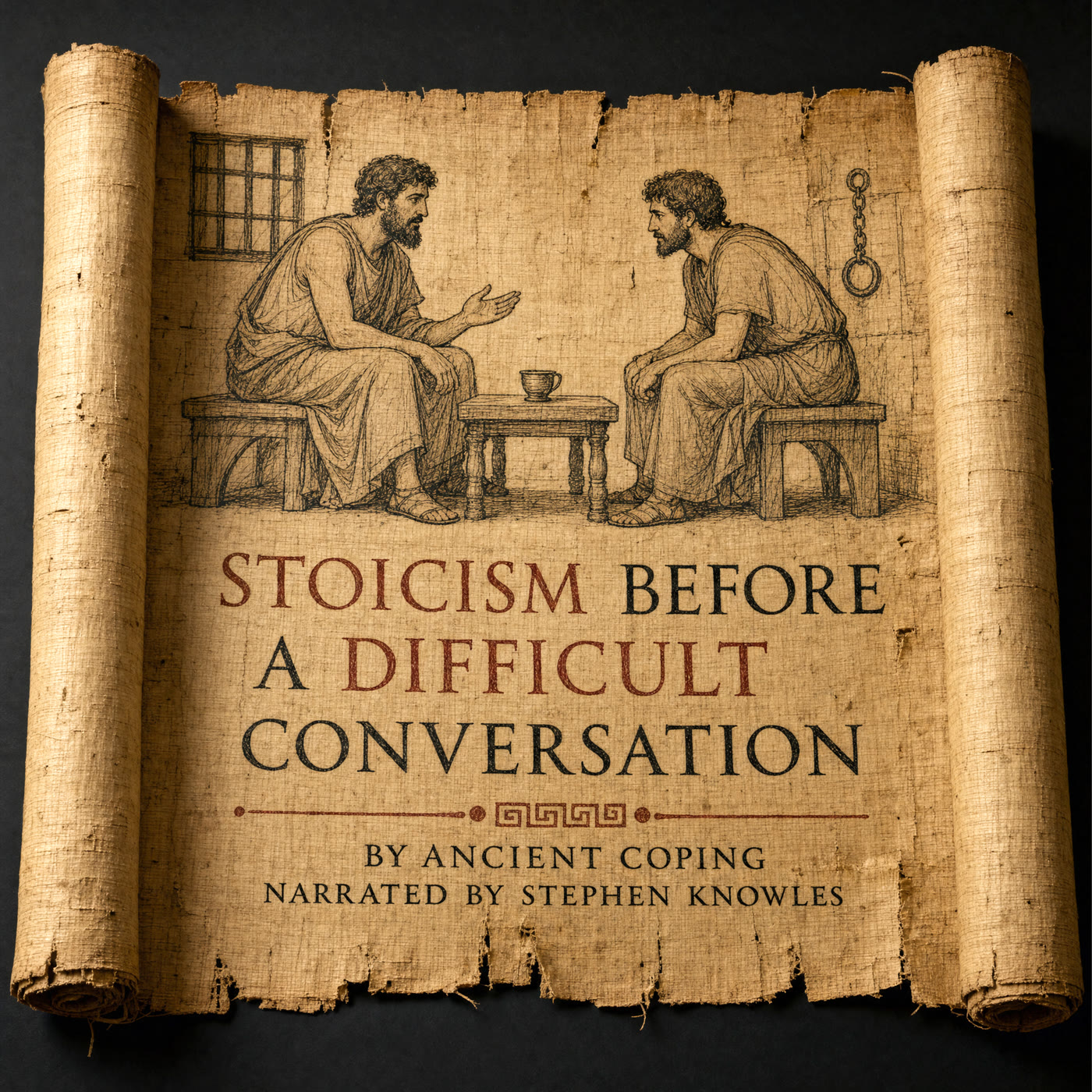
Stoicism Before a Difficult Conversation runs about forty minutes. It gives you six tools for the talk you have been avoiding: how to find the one true sentence under the hinting, how many words to use, how to ask questions that let the other person say the truth first, and how to prepare for their best reply and not your worst fear. It also covers how to take correction gladly, and how to pick the hour, follow up, and recover if it goes badly. You follow Will, a manager with three conversations he has put off for a year, one of them with his wife, Ruth, about the drift between them. It ends with the last day of Socrates, and what he did with the time he had left to speak.
Questions people ask
My husband is having a midlife crisis. What helps, and what doesn't?
What helps: a calm, specific invitation to talk, being clear about what you are feeling, and asking him real questions without accusing him. What doesn't: ultimatums in the middle of a fight, mocking him, or trying to fix his mood for him. You can offer support and still insist that he be honest with you.
What boundaries are fair if my spouse is acting out or pulling away?
You are allowed to ask for honesty, for the end of any secret contact with another person, and for counseling, and to say what you will do if none of that happens. A boundary is about what you will do, not a threat meant to control him. Your needs and your safety count too, and so does getting support for yourself from a friend or counselor.
Will he come back to normal, or is the marriage over?
No one can say. Many couples come through a hard stretch like this, and some do not. The best signs are honesty, willingness to see a counselor, and effort that lasts months, not days.
He is on dating apps or may be having an affair. What now?
Ask him directly and calmly, at a time when neither of you is exhausted or drinking, and be ready to hear an answer you won't like. If it is true, a counselor who works with infidelity can help you both. You decide what you need to feel safe, and rebuilding trust depends on his transparency over a long stretch, not one apology.
Can a marriage recover after infidelity or an emotional affair?
Some do, and some don't. Recovery usually depends on the affair actually ending, full honesty from the one who strayed, patience from both of you, and usually professional help. The spouse who was hurt sets the pace, and rebuilding often takes a year or more.
Should we separate, divorce, or renew our vows?
Try not to choose any of them until you have had at least one honest conversation, ideally with a counselor involved. If you do separate, set it up with a plan and an agreed timeline instead of walking out in a fight. Renewing vows can be meaningful, but it works as a result of repair, not a substitute for it.