It is 11:40 on a Sunday night. You sent a proposal on Friday and the client hasn't answered. You open your email. Nothing. You close it and open it again. You have already rehearsed the “we went with someone else” reply, and the “we love it” reply, and you have no idea which one is real.
The dichotomy of control is built for this exact night. It is the first idea in Epictetus's Handbook: some things are up to you and some are not, and life goes better when you stop treating the second kind as the first. Below is what he actually wrote, what people get wrong about it, what to do with things you only partly control, and a two-minute exercise you do on paper.
What Epictetus actually said
Epictetus was born a slave in the Roman world around the year 50 and walked with a limp. After he was freed he taught in Greece. A student named Arrian wrote down his lessons, and the short version is the Handbook, or Enchiridion. It opens like this:
Of things some are in our power, and others are not. (Epictetus, Enchiridion 1, George Long translation)
Then he sorts them. Up to us, in his words: our opinions, what we reach for, what we want, what we avoid. In short, our own acts. Not up to us: our body, our property, our reputation, our official positions. In short, whatever is not our own doing.
Then he gives the consequence. Treat the first group as yours and nobody can block you. Treat the second group as yours and you will be thwarted, upset, and looking for someone to blame.
The phrase “dichotomy of control” is a modern label. Epictetus just said some things are up to us. That plain sentence is the whole foundation.
What is actually in your control
The Greek word Epictetus leans on is prohairesis. It means your faculty of choice, the part of you that decides. Put practically, three things sit inside it:
- Judgments. What you tell yourself a situation means.
- Choices. What you go after and what you steer away from.
- Actions. What you do with your hands, your mouth, and your time.
Judgments are where it gets interesting. A first impression arrives uninvited: the client is silent, so they hate it. You didn't choose that thought. What you choose is whether you say yes to it. The Stoics called that yes “assent.” You can say, “That is how it looks. I don't know yet.” That small pause is most of what Stoics mean by self-control. It isn't white-knuckling your feelings. It is governing what you agree to and what you do next.
What isn't on the list: the client's answer, the market, your boss's mood, your body's long-term plans, and what people say about you.
What it does not mean
Three misreadings come up constantly.
- “So I should give up.” No. Everything on the first list demands your full effort. A man who says “it's out of my hands” and does nothing has failed at the only part that was his.
- “So I shouldn't care.” No. Epictetus talked about duties to family, neighbors, and country. The point is not to love less. It is to stop trying to own what you love and cannot command.
- “So I shouldn't feel anything.” No. The first jolt of fear or anger isn't a failure. What you do with it, which judgment you sign off on, is the part that counts.
He wasn't a tough guy telling you to suck it up. He was a former slave who knew exactly how little a man can command, and who built a life on the rest.
The gray zone: things you partly control
Here is the objection that keeps this idea from feeling tidy. Most of life is partly up to you. The proposal. Your health. Your kid's grades. Epictetus filed the body and reputation under “not ours,” flat out. Is that fair?
The Stoics had an answer. The Roman writer Cicero, in On Ends (3.22), reports their picture of an archer. He picks his bow, trains for years, stands well, aims, and releases cleanly. All of that is his. Once the arrow leaves, wind and a moving target take over. So what is the archer's real task? To shoot well. He prefers to hit the target, and he aims at it, but his job is the shot.
Modern writers sometimes call this a “trichotomy,” a third bucket of things partly in your control. The ancient Stoics didn't use that word, but the idea is there. They called outside things like health and income “indifferents,” meaning they don't make you a good or bad man. Some were “preferred indifferents.” You may sensibly go after them, just not at the price of your character or your peace.
So with a partly-yours thing, split it in two:
- Your effort: yours. Prepare, aim, follow through.
- The result: not yours. Aim at it without making it a verdict on you.
Back to the proposal. Your side: check the numbers, write it clearly, send it, follow up once on Tuesday. Their side: budget, timing, a cousin who needs the contract. Refreshing your inbox at midnight belongs to neither list. It is just a way of being upset.
Epictetus used a similar picture with a ball game. Good players don't argue with the ball. They catch it and throw it well. For more lines from him and others, with their sources, see Stoic quotes that are real.
The two-minute exercise
This works on any worry: money, a diagnosis, a teenager, a layoff rumor. You need a pen and a page. Longer prompts live on the Stoic daily practice page, but this is the core.
- Name it in one sentence. Example: “The client hasn't answered my proposal.” Facts only.
- Draw a line down the page. Label the left side “Mine” and the right side “Not mine.”
- Fill the right side first. Everything that will be decided by someone or something else. Be honest. It is usually the longer list.
- Fill the left side. Only actions and judgments. “Send one follow-up Tuesday morning.” “Stop checking email after 9 p.m.” “Decide what I'll do if it's a no.”
- Check your judgment. Under the line, finish this sentence: “The story I'm telling myself is…” Then write a plainer version: “What I know is…”
- Circle one item on the left and give it a time in the next 24 hours.
- Write one closing line: “The rest is not mine tonight.”
Then do the circled thing, or go to bed. When the worry comes back, don't argue with it. Look at the page and ask whether the new thought is on the left or the right.
One honest note. This is for the ordinary weight of a life full of things you can't run. If your worry is constant, you aren't sleeping or eating, or you're carrying grief that hasn't eased in months, talk to a doctor or counselor. Don't handle it alone. If you ever think about harming yourself, call or text 988 in the US.
You won't do this perfectly. Epictetus said most of his students never fully got there. But each time you sort a worry and act on your own side of the line, you get a little of the freedom he was describing.
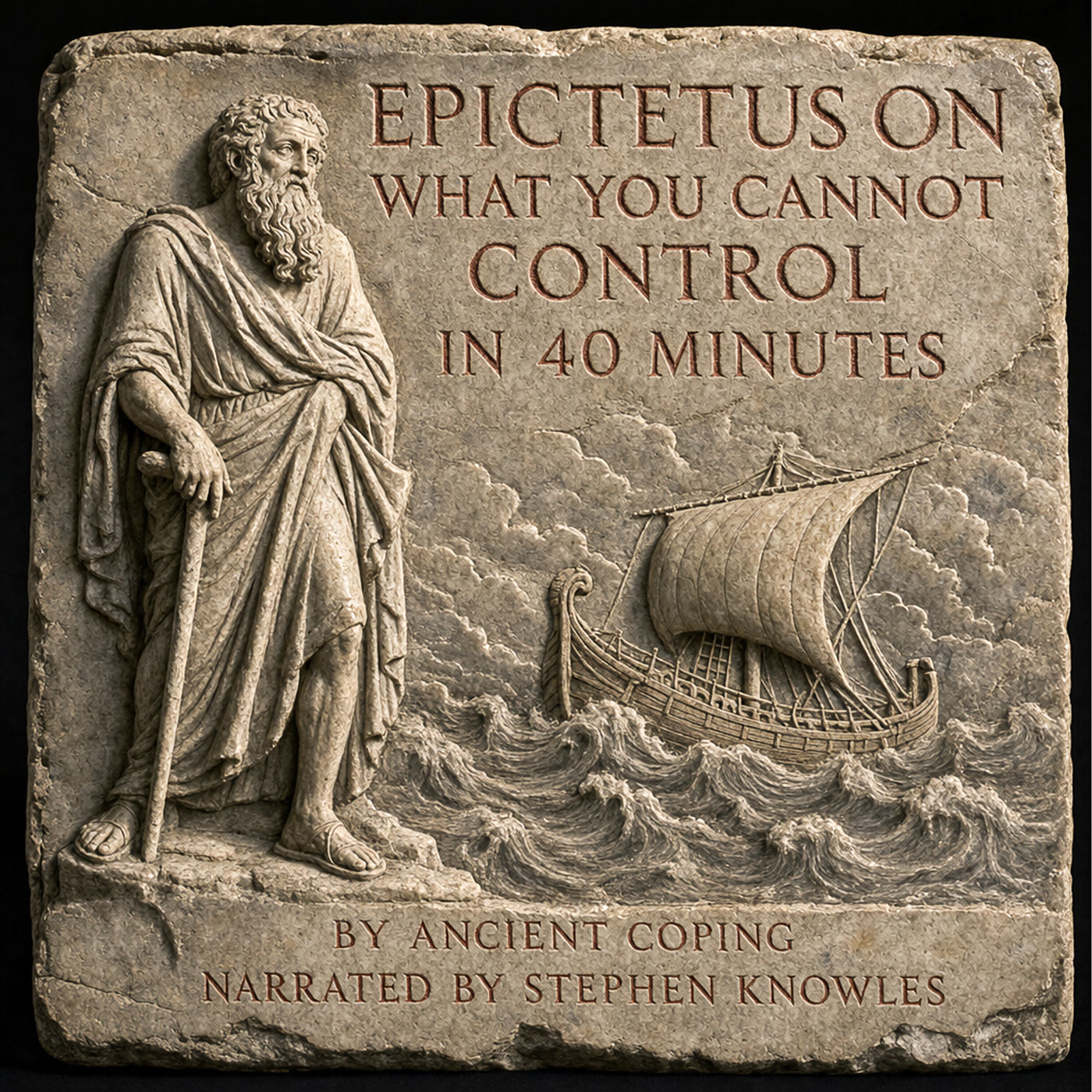
Epictetus on What You Cannot Control in 40 Minutes goes further in about forty minutes. It tells the story of the senator who went to lunch after being condemned, and follows Rob, a man whose company, mother, and son all give him bad news in one autumn. It covers Epictetus's ball game, the ship and the shore, and a before-and-after method for any big task. It also explains what to do when something is taken from you, gives a short phrase for facing what has already happened, and ends with a seven-day plan.
Questions people ask
What is the Stoic idea of assent and impressions?
An impression is the first appearance of a situation, like “they're ignoring me.” Assent is the step where you agree to it and treat it as true. The Stoic skill is to notice the impression, hold off on the yes, and ask what you actually know. Stoic writers also spoke of “kataleptic” impressions, ones clear enough to trust, as opposed to hazy ones that need checking.
Do the Stoics believe in free will or determinism?
The early Stoics held that events follow from prior causes, so they were determinists. They still held that your choices count as your own, because they flow from your character and judgment. Scholars argue about how neatly that fits together, so treat it as a debated question, not a settled formula. Epictetus's practical point doesn't depend on solving it: put your effort into your judgments and actions.
What is amor fati, and is it the same as Stoic acceptance?
Amor fati is Latin for “love of fate,” a phrase tied to Nietzsche, not the ancient Stoics. The Stoic version is plainer: don't fight what has already happened, and ask what you can do with it. Epictetus's line about wishing things to happen as they do happen is the closest ancient match. It doesn't mean pretending a loss is good. It means not adding a second wound by refusing reality.
What are preferred indifferents?
They are outside things like health, a decent income, and good friends that the Stoics said you may reasonably prefer. They are “indifferent” because having them doesn't make you a good man and lacking them doesn't make you a bad one. You go after them with effort, but you don't sell your integrity to get them.
What are the three Stoic disciplines?
They are desire, action, and assent. In rough terms: want only what is up to you, act well in your roles with other people, and be careful what you agree to in your own mind. The dichotomy of control is the base of the first one. Modern readers often organize Epictetus's teaching this way, though the Handbook doesn't lay it out as a neat list.
Is this Stoicism for air traffic controllers?
Not really, though the search is a fair joke. A controller can't decide the weather, delays, or what pilots do. They can follow procedure, stay focused, and communicate clearly, and that is the dichotomy at work. Epictetus's idea is about where you put your effort and your peace, not about having a job that involves controlling things.