It's your lunch break and you're scrolling. A marble bust of a bearded Roman. Over it, in bold type: Be unbothered. Outwork everyone. Next post, another bust, another quote with no source. Somebody in the comments says Stoicism changed his life. Somebody else says it's just gym-bro talk.
You wonder which is true. Neither, really.
Stoicism is an ancient school of practical philosophy. It teaches you to sort what is up to you from what isn't, to examine your judgments before you react, to aim at good character, and to remember that your time is limited. It does not ask you to feel nothing, and it is not a hustle plan. It's a set of habits, and you can begin this week.
What Stoicism is, and where the name comes from
Around 300 BC, a merchant from Cyprus named Zeno started teaching in Athens, under a painted colonnade called the Stoa Poikile. People called his followers "Stoics," after the porch. The school taught logic, a view of how the universe works, and ethics. Ethics is the part that lasted: how a person should live.
Three Romans carry most of what you'll read today:
- Seneca was a statesman, writer, and wealthy adviser to the emperor Nero. His Letters to a younger friend are warm, funny, and practical. He was also compromised by his proximity to power, and he knew his critics said so.
- Epictetus was born enslaved, walked with a limp, and was later freed. He taught in Greece. A student, Arrian, wrote down his lessons, including the short Handbook. His teacher, Musonius Rufus, was another Stoic worth knowing.
- Marcus Aurelius was emperor of Rome. His Meditations are private notes to himself, written during wars and plague. He never meant them for readers.
These men lived in a slave society with brutal politics, and nobody should copy all their views. What's worth taking is the method.
Four ideas worth knowing first
1. Control. The Handbook opens by dividing the world in two. Up to you: your judgments, choices, and actions. Not up to you: your body, your reputation, your job, other people's decisions. Epictetus taught in a world where an emperor's mood could cost a man everything. Today it looks like a layoff rumor or a text left on read. Put your effort on the first list, and stop paying rent on the second.
2. Judgments. Between the event and your reaction sits a story you tell about it.
Men are disturbed, not by the things which happen, but by the opinions about the things. (Epictetus, Handbook 5, George Long translation)
He did not mean that nothing hurts. He meant that the event and your verdict on it are two separate things, and only one is yours to examine. Your boss sends a short email. The email is a fact. He's out to get me is a judgment.
3. Virtue. The Stoics named four: wisdom, courage, justice, and moderation. They argued that character is the one thing nobody can take from you, so it should be the main aim. Health and money are fine to want, but they're not the measure of a man. "Wisdom" here is practical: knowing the right move in the real situation in front of you.
4. Mortality. Marcus kept reminding himself, roughly, that life is short and that he could be gone soon. Seneca wrote that we aren't given too little time, we waste a great deal of it. This is not morbid. It's a way of deciding what is worth your evening.
A note on timing: Epictetus put these ideas to students who were training to live by principle. Now they're mostly useful to a man at a desk with a phone that won't stop buzzing. The ideas haven't changed. The setting has.
Three myths to drop
"Stoics feel nothing." Seneca wrote letters consoling friends in grief. In one of them he says, roughly, that you shouldn't keep your eyes dry at a friend's death, and you shouldn't let them flood forever. The goal was not to be numb. It was to avoid being ruled by a feeling. A first jolt of fear or anger is normal. What you do with it next is the work.
"Stoics are passive." Marcus ran an empire. Epictetus insisted on full effort in everything that's yours. "I can't control the outcome" is not an excuse to stop trying. The archer still has to draw the bow.
"It's a hustle philosophy." The Stoics didn't teach you to get rich or win. They treated money, status, and health as things you may prefer but shouldn't depend on. Seneca was rich, and people pointed out the gap between his words and his bank account. So read the Stoics for the ideas, not to find a hero. And if a post pairs Marcus Aurelius with a grind-harder slogan, check it against the real text before you trust it. Our page of Stoic quotes that are real, with sources can help.
Where to start: one exercise, one book
The exercise: take one thing that's bothering you. Draw a line down a page. On the left, write every action that's actually yours to take. On the right, write everything someone or something else will decide. Be honest about the right side. It's usually longer than you'd like. Then do the left side.
The book: the Handbook of Epictetus. It's short, it's in the public domain, and the George Long translation is free online. Read sections 1 through 5 and stop. That's enough to give you the control idea and the judgments idea in the man's own words.
Your first week
- Day one. Do the two-column page for your biggest worry.
- Day two. Read Handbook sections 1 to 5. Write one sentence on which line stung most.
- Day three. Catch one judgment. Write the fact on one side and the story on the other.
- Day four. Do one item from your left column that you've been putting off.
- Day five. Before bed, ask: what did I do well today, and what would I change? No self-attack, just notes.
- Day six. Pick one small irritation, such as traffic or a slow line, and use it for practice. Say to yourself: this is what's here. What now?
- Day seven. Look back at the page from day one. What moved? What was never yours? Pick one more prompt from our Stoic daily practice page for next week.
A serious word. Stoicism is a way of thinking, not treatment. If worry or low mood has become constant, if you're not sleeping, or you're thinking about harming yourself, talk to a doctor or a counselor. In the US you can call or text 988 at any hour. Don't carry it alone.
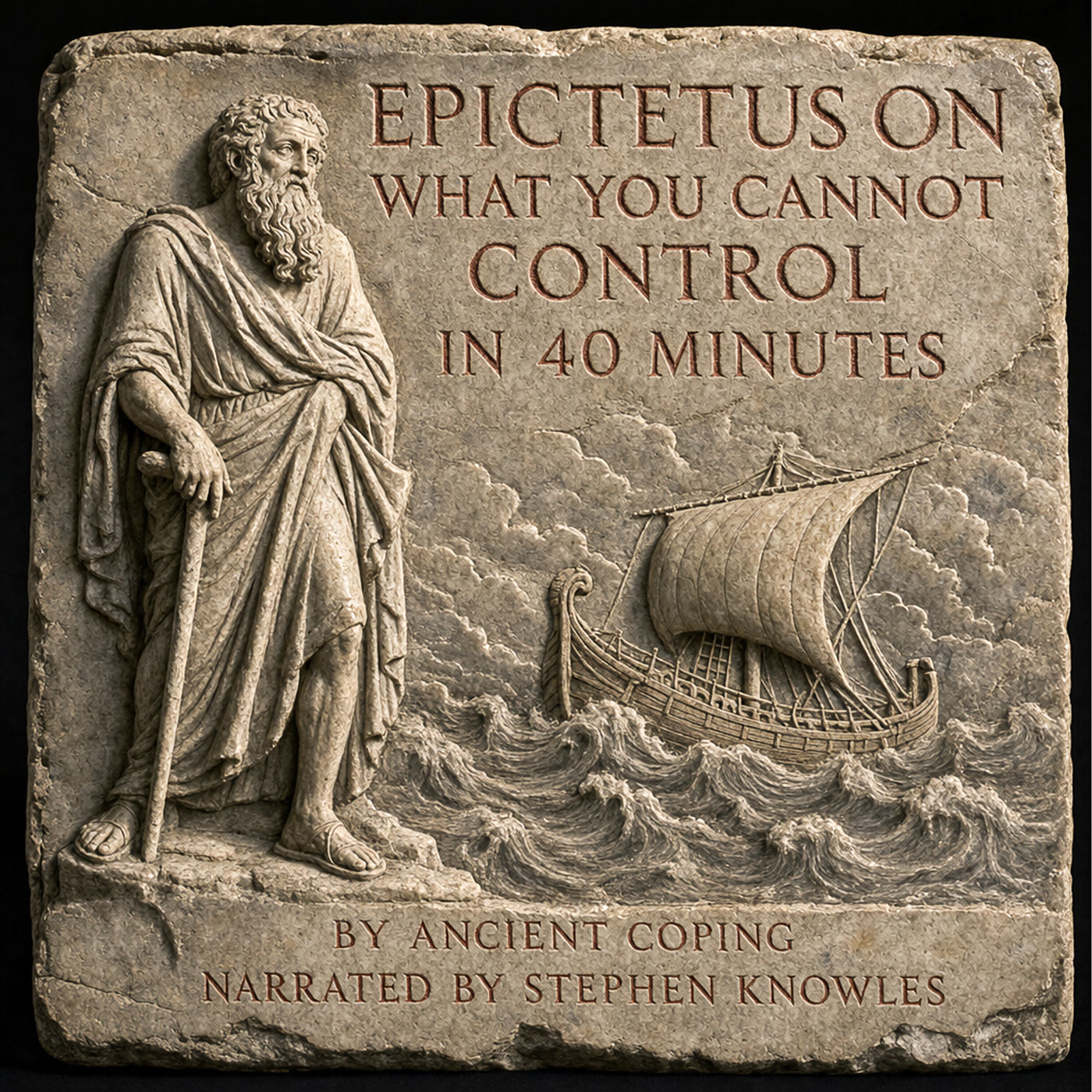
Epictetus on What You Cannot Control in 40 Minutes takes the control idea from this letter and goes much deeper. It opens with the senator who heard he'd been condemned and went to lunch. It then walks through the images Epictetus used for acting well when the outcome isn't yours, including a ball game, a ship, and a returned loan. It covers the middle ground of things you can influence but not decide, the two ways men misuse the idea, and a plan for seven days. Along the way you follow Rob, a man whose company, mother, and son all change in a single autumn, as he learns what is his to carry.
Questions people ask
What should I read after the Handbook?
Most beginners go next to Seneca's letters to Lucilius, which are short and conversational, and then to Marcus Aurelius's Meditations. Meditations is a private notebook, so it reads best a few pages at a time. Pick a public-domain translation to start, then buy a modern one if you want smoother language.
Is there a Stoic study guide or syllabus I can follow?
A simple one is Handbook sections 1 to 5, then a few of Seneca's letters, then Meditations a page a day. Add one practice each week, such as the two-column page, a daily review, or the pause on judgments. You don't need a paid course to start.
What did the Stoics believe about the universe and the old myths?
Stoic natural philosophy held that the universe is rational and ordered, and they often spoke of nature, reason, or providence guiding it. They tended to read Greek myths as allegory rather than literal stories. You can use the ethics without accepting the physics, as many modern readers do.
Is Stoicism a religion?
No. It has no church, creed, or required worship. The ancient Stoics talked about gods and a rational cosmos, but the everyday practice, sorting what's yours from what isn't, works for people of any belief or none.
How are Epictetus and Marcus Aurelius different?
Epictetus was a teacher speaking to students, and his lessons are blunt and organized around control and choice. Marcus was an emperor writing to himself, so his notes are more personal and often about duty, patience, and mortality. Read Epictetus for the method and Marcus for the practice.
How long until Stoicism makes a difference?
It isn't a switch, and no one can promise an outcome. Many people notice small shifts within a couple of weeks, like catching a judgment before reacting, but the habit builds over months. Treat the first week as a trial.