It's 3:10 a.m. Nothing woke you. No noise, no kid, no bladder. Your mind just clicked on.
It starts with something you said in yesterday's meeting. Then it jumps to the conversation you have to have Thursday. Then to the twinge in your side. Then to the money. Then back to the meeting, from a new angle. Every thought feels urgent. None of them goes anywhere.
You can't stop overthinking by trying harder to stop. That's like trying to calm a dog by shouting at it. What works is smaller and more practical: test the thought, then get it out of your head. Two men who lived nearly two thousand years ago did both, and they were not living easy lives.
Why the mind does this: it's running on imagination
Seneca was a Roman writer and statesman. He was exiled for eight years. He had lung trouble most of his life. He served under Nero, who eventually ordered him to kill himself. He knew real trouble. And in a letter to his friend Lucilius, he made an observation about worry that still holds up.
"There are more things, Lucilius, likely to frighten us than there are to crush us; we suffer more often in imagination than in reality." (Seneca, Letters to Lucilius 13)
In his time, this was advice to a friend who was frightened of things that hadn't happened yet. Today it describes the 3 a.m. loop. Most overthinking isn't thinking about problems you have. It's thinking about problems you might have, in full detail, over and over.
Seneca's other point is about cost. Roughly, he said that a man who suffers before it's necessary suffers more than he needs to. If the bad thing happens, you suffer once for real. The overthinker has already suffered it a dozen times in rehearsal. If it doesn't happen, he paid for nothing.
Seneca wasn't scolding anyone. He was asking you to notice the price.
Step one: ask for the evidence
Seneca's remedy was to examine the fear instead of just feeling it. Roughly, he said we accept what we fear without checking it. We believe a rumor, a guess, a look on someone's face.
So ask two questions:
- Is this happening, or am I imagining it might happen?
- What's the actual evidence? Not the feeling or the story. Facts you could show another person.
Be strict. Here's what the "evidence" usually looks like:
- She didn't reply for two hours.
- My boss said "got a minute?" and didn't smile.
- I read an article that said this symptom could be serious.
That's not evidence of disaster. That's a seed, and your mind grew a forest from it.
Sometimes the test shows the problem is real: an actual debt, an actual symptom, an actual conflict. Then the answer isn't more thinking. It's one action. Make the appointment. Send the message. Look at the number. The test isn't there to talk you out of real problems. It sorts the real ones from the imagined ones.
Step two: get it out of your head
Marcus Aurelius ran the Roman Empire. He also kept a private notebook, which we now call the Meditations. It was never meant to be published. He wrote much of it at night, on military campaign, after a day of war and paperwork.
And what did the most powerful man in the world write about? His own troubles: irritation, fear, fatigue, the urge to quit. He'd state the thought, argue with it, and remind himself what he believed. Then he'd come back a few days later and do it again. He never finished the job. That's the comforting part. If an emperor needed the page every night, you can need it too.
He also gave a reason to bother. In George Long's translation, he wrote that "the soul is dyed by the thoughts." He was talking about habit. Whatever your mind soaks in most, it slowly takes on the color of. A mind that spends hours in dread gets good at dread.
Writing helps because a thought in your head can loop forever, changing shape and never finishing. A thought on paper holds still. You can see how small it is, or how many times you've had it. Benjamin Franklin made a similar point in a 1772 letter to a friend facing a big decision. Roughly, he said hard choices are hard because we can't hold all the reasons for and against in our minds at once. So he put them on paper, in two columns, where he could see them together.
Paper holds what your head can't.
A short note on the first second
The loop often grabs you before you can test anything. Epictetus, a former slave turned teacher, described the first flash of thought as an "impression." You don't choose it. What you do next is the part that's yours. His advice was to say to the impression: "Appearances, wait for me a little: let me see who you are, and what you are about: let me put you to the test."
You don't have to fight the thought. You just don't have to jump on it and ride wherever it goes. Silently name it: that's the money worry. That's the replay. A name puts a small gap between you and the thought. That's often enough.
Your practice for this week
You need a pen and a notebook. Keep it by the bed, on paper, not your phone. The screen will pull you into the very thing you're trying to leave.
- Tonight, before bed: Write down what's on your mind in a few plain lines. Don't make it pretty.
- Under it, write the evidence. One line: what do I actually know? Only facts.
- Write one line back to yourself, as Marcus did. Something you'd say to a friend in the same spot. They interviewed me three times. They picked me. That kind of thing.
- Close the notebook. It's recorded. Your mind doesn't have to keep repeating it to make sure you heard.
- If you wake at night, turn on a small light and do steps 1 through 3 again. Name any new thought that shows up, wait a little, and let it pass.
- Day by day, circle the worries that had real evidence behind them. Do one concrete thing about each of those. Leave the rest on the page.
- At the end of the week, read back through. Count how many were real and how many were imagination. Most people are surprised by the ratio.
Some notes. You'll slip back, and that's normal. Marcus kept returning to the page for years. Also, you don't need to empty your mind. The goal is to end the pointless loops so you have room for useful thinking.
If this has gone on for weeks or months, and it's hurting your sleep, your work or your relationships, talk to your doctor. That's not a failure of method. Overthinking can be part of anxiety or low mood, and real help exists. You don't have to handle that alone. If your thoughts ever turn toward harming yourself, contact a crisis line or emergency services where you live right away.
These two steps are a start. They won't fix everything, but they'll give you something to do at 3 a.m. besides lose the argument with your own head.
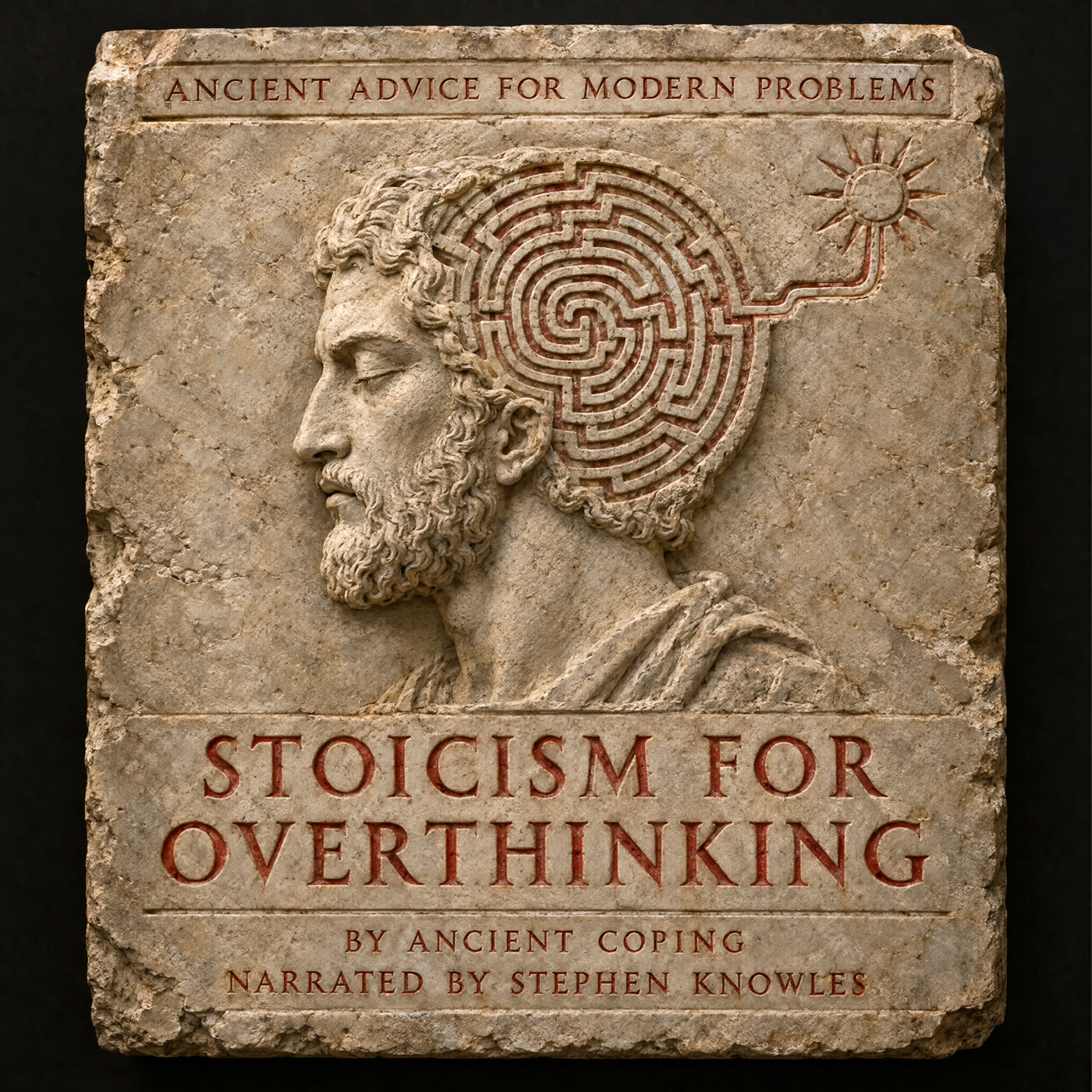
This is only part of what's in Stoicism for Overthinking, a forty-minute audiobook that goes further. It covers how to follow a fear to its actual end instead of looping at the edge, Marcus's one question for cutting your mental load, what to do when you're stuck on a decision, and the letter Seneca wrote from a room above a noisy Roman bathhouse. It also covers common moments like an unanswered text, a symptom search, a replayed conversation and a report you can't stop rewriting, and a seven-day plan to tie it all together.