It's 4:10 a.m. and you are awake again. The phone is already in your hand. You check the email about the restructuring. Nothing new since eleven last night. You check it anyway. Then the bank app. Then the news. Then the email again.
None of this changes anything. You know that. Your body doesn't care. It is braced for something, and it won't tell you what.
A teacher named Epictetus spent his life on this problem. He was born a slave in the Roman Empire and was lame in one leg. He knew what it was to have almost nothing under his own control. His students wrote down his lessons, and his answer to worry is still one of the most usable ever put on paper.
Sort the worry into two lists
The Handbook, a short collection of his teaching, opens with the idea everything else rests on:
Of things some are in our power, and others are not. (Epictetus, Enchiridion 1, trans. George Long)
In his time, this was a plain statement about freedom. A slave could be beaten, sold or moved at another man's word. Epictetus wanted his students to see what no owner, emperor or court could reach: their own judgments, choices and actions.
Here is what that looks like now.
Within your power:
- What you decide to think about a situation
- What you choose to do, and how you do it
- What you go after and what you steer clear of
Not finally within your power:
- Your body, including illness and aging
- Your job, and whether the company gets sold
- Your reputation
- Your money, once the market moves
- Other people, including your kids, your parents and your boss
That second list is longer than most men want it to be. Epictetus wasn't being gloomy. He was being accurate. Most of what wakes you at 4 a.m. is on it.
There is a belief under a lot of this worry, and it is usually unspoken: a good man prevents bad things. If your son makes a mistake, you failed. If the layoff comes, you failed. The outcome becomes a verdict on you. Epictetus would point out that bad things happened to Socrates, who was executed, and to Epictetus himself. Nobody calls them failures. The measure of a man is how he conducts himself in what comes.
Care about the result, but own the effort
Here is the fair objection. "If I stop worrying about things I can't control, won't I stop trying?"
No. The Stoics had an image for this, which the Roman writer Cicero recorded: an archer. He picks a good bow. He practices for years. He stands, aims, draws and releases as well as he can. All of that is his, and he should do it fully.
Then the arrow leaves the bow. A gust of wind, a moving target or a flawed arrow can still decide the outcome. The archer's real job was to shoot well. Hitting the target is what he aims at. Shooting well is what he answers for.
So you can want the outcome, aim at it, and work hard for it. What you stop doing is making your peace depend on it.
Two ways to get this wrong:
- Passivity. "It's out of my control" is not a license to do nothing. Epictetus demanded full effort on the first list. The archer still has to draw the bow.
- Coldness. This is not a way to stop caring about your kid or your mother. The point is to love them without trying to run their lives.
Know what worry is actually doing
Seneca, a Roman statesman who wrote letters to a friend named Lucilius, noticed the same thing. In Letter 13 he told Lucilius that we suffer "more often in imagination than in reality." He was writing to a man anxious about a lawsuit. His point was not that nothing bad ever happens. It was that the mind rehearses disasters over and over, and pays for each one in advance.
That is what the 4 a.m. refreshing is. It feels like work, but it is rehearsal. And the rehearsing often hides a quieter fear: that you didn't really do your part.
Epictetus told a story about a senator named Paconius Agrippinus. A messenger found him at the baths and said his case was being heard in the Senate. In Nero's Rome, that could end in exile or death. Agrippinus said, good luck to it, and went on with his usual exercise and cold plunge. When the messenger returned and said he had been condemned to exile, Agrippinus asked about his property. It had not been seized. "Let us go to Aricia then," he said, "and dine."
You don't have to take that as a model. Agrippinus was a senator, and the story is polished by retelling. But the lesson holds. He did what was his to do, and he did not spend the morning pacing outside a verdict.
A practice for this week
You don't need the full method to start. This much will already change a week.
- Pick one worry. Choose the one that woke you up most recently.
- Draw a line down a page. On the left, write every action that is yours to take. On the right, write everything that will be decided by someone or something else. Be honest. The right side will be long.
- Do the left side. Make the call. Book the appointment. Update the résumé. Say the thing to your son once, plainly. If an item is done, cross it off.
- Name a stopping point. Once the left side is finished, say it to yourself: "That's my part, and it's done." Choose a time, such as Sunday night, after which you stop going over it.
- When the worry comes back, ask one question. "What is mine here?" If nothing is, put the phone down. If something is, do it, or write it on tomorrow's list.
- Cut one input from the right side. Set a limit on one thing: checking the news, the inbox, a forum, the balance. Once a day is a reasonable limit. Keep it for seven days.
You will slip. Epictetus said himself that most of his students never fully got there. Each time you catch yourself and return to the left side, though, you have practiced the skill.
One serious note. This is for the ordinary weight of a life full of things you can't control. If your worry is constant, if you aren't sleeping or eating, if grief hasn't eased after many months, or if you have thoughts of harming yourself, please talk to a doctor or counselor. And if you are looking after someone seriously ill, find support for yourself too. Carrying it alone isn't strength.
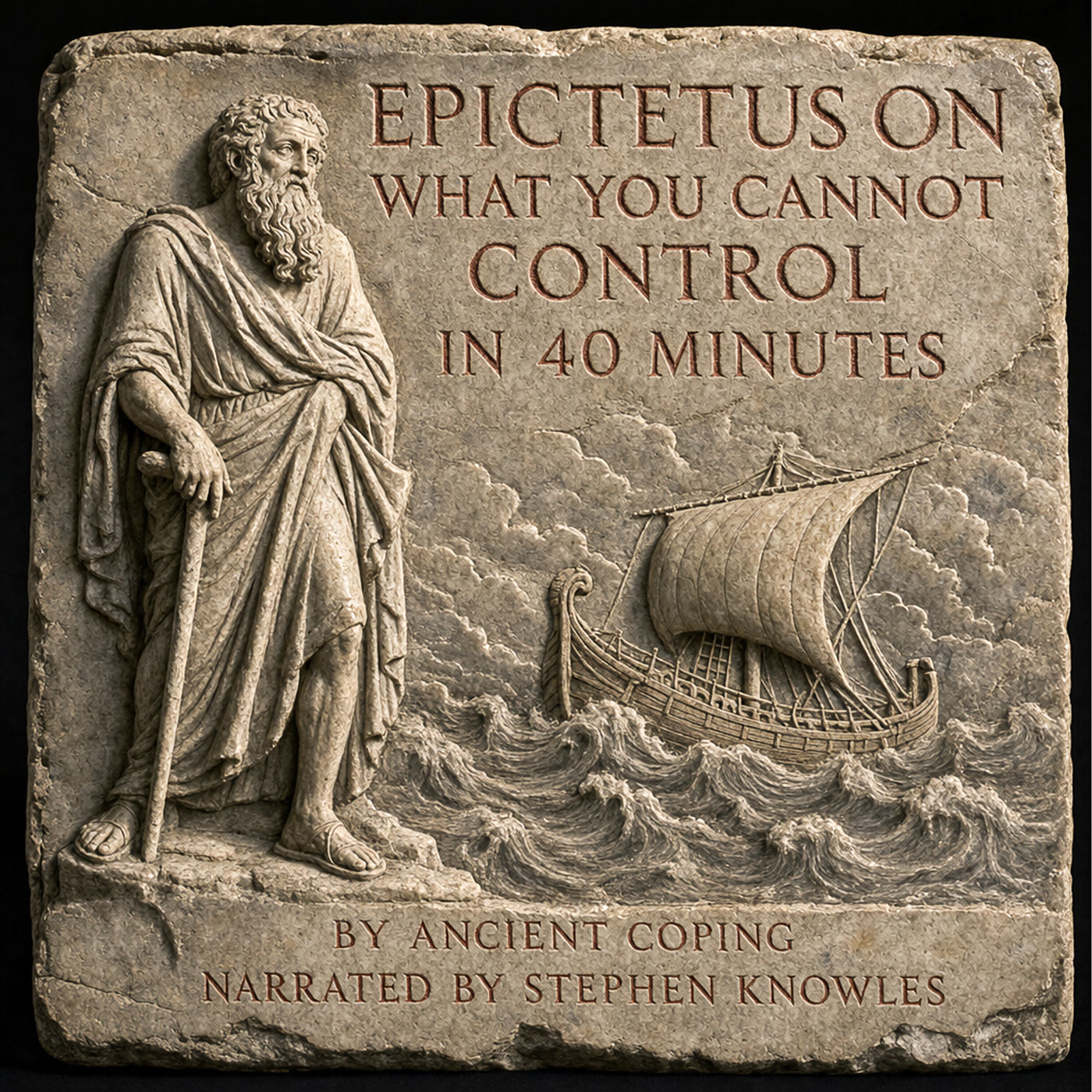
Epictetus on What You Cannot Control in 40 Minutes goes further than the sorting rule. It takes up the hard middle ground of things you can influence but not decide, and Epictetus's picture of life as a ball game, which gives you a way to act when the result isn't yours. It covers his images of the ship and the returned loan for holding on to people and things without gripping them. It also applies all of this to a grown child's choices, a layoff, bad health news and an aging parent, and ends with the sentence of his that many people find both the hardest and the most freeing.